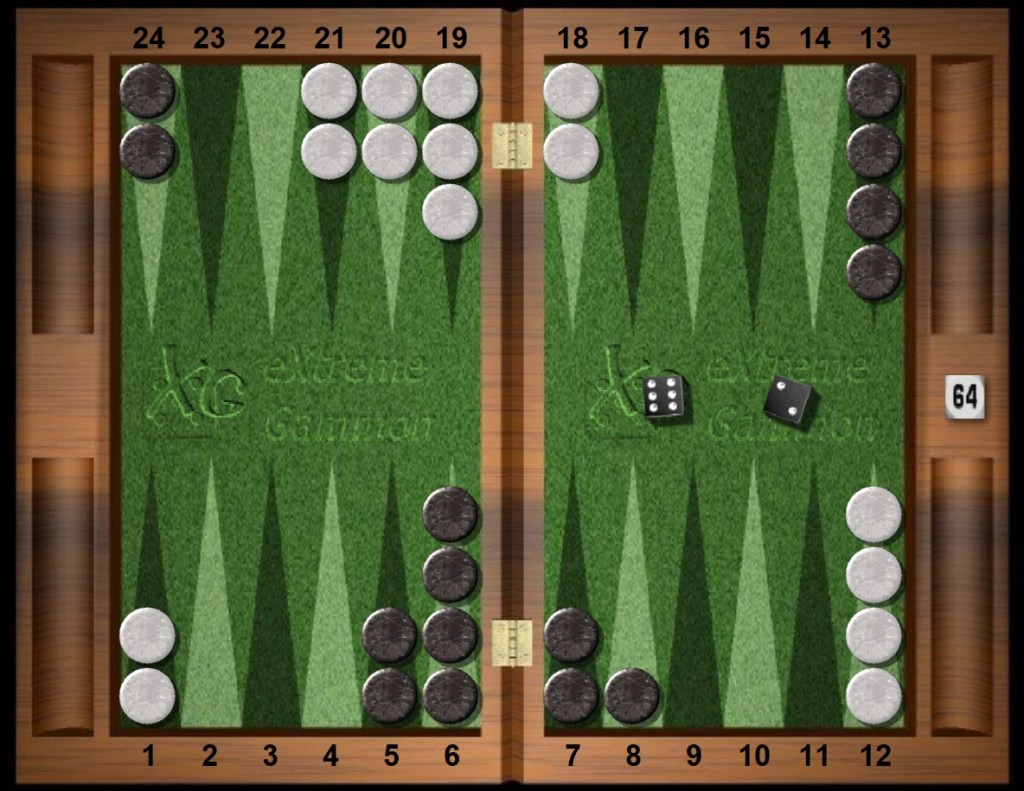
One-six. White opens by making her barpoint.
Six-one. Black responds by making his barpoint.
One-three. White makes her golden point.
Three-one. Black also makes his golden point. Monkey see, monkey do.
Two-four. White continues to build assets. White makes her four-point, the home trinity. So far in this game the sentiment mirrors the quiet yet deadly buildup of warlike power reminiscent of the decade before the outbreak of the Great War. Isolated. Not much happening. Yet a sense of dread.
Six-two. Black cannot make a new point. It is decision time.
Black can run with 24/16.
Black can hide with 13/5.
Black can dangerously split to the 22pt and add a spare to the barpoint.
Black can bring two checkers to the 7pt and 11pt, continuing a warlike buildup.
Three of the plays are blunders. No pressure, right? Think it through.
Plonking a midpoint spare onto the 5pt with the hide play 13/5 tries to calm the situation. White is developing better but Black 13/5 offers no more targets to hit and allows some chance of continuing a smooth development. White still has the six shots to hit the black 8pt blot and White still is stronger. Black’s spares are too forward, which may become awkward later should White upgrade her anchor. In this position, making the rear points of a black blockade seems more natural, more balanced.
Pulling both spares down from the 13pt strips the midpoint, perhaps stranding the black backmen later, but aims now to expand the black blockade from the rear, should the dice rolls cooperate. White retains the same six direct shots since the black 11pt blot does not build inside Black’s home board, only in Black’s outfield. The builder is tucked away. It discourages White from running. However Black has just duplicated his own threes, blending an ordinary 8pt with the vital 4pt.
When both players start with parallel game plans – run versus run, block versus block, attack versus attack – there inevitably come a moment in the game when one player admits that this parallel plan is flawed. At that moment be bold and switch to another plan. In doing so, be sure to trim down the commitments of the new plan. Create more bite-size objectives and then achieve them.
The Great War began with an assassination in the Balkans. Similarly, running to the 16pt provokes White into hitting. Black’s backmen are no longer connected. Successful running as a game plan commits Black to charging twice through a gauntlet. Pause is always fatal. Therefore, for the next few rolls, even with good outcomes, Black must commit to running, and nothing else. Meanwhile White’s next tactical objective already is to bring down a midpoint spare or two in order to extend her prime. Offering a black blot in her outfield just helps White.
Dangerous as it seems, Black must engineer his defence in smaller stages, with more tactical objectives. First, split to the edge of the white prime before White adds more builders. Second, grab an anchor. Most important, then wait safely. The gauntlet is paused after a 22pt anchor. Now return to construction of Black’s blockade and hope to avoid the gauntlet altogether by waiting for big doubles on the dice, by White overrunning her own forward blockade, or by a black counter-prime of White with better timing for Black. Perhaps White’s blockade will crack first.
Play 13/7 24/22 with enthusiasm, confident of the need for a new game plan.
 the baron talks backgammon