Black gets ready to roll the dice, but stops. Time to consider a first cube. Before this moment, the white and black outfield checkers were staring each other down, menacingly. But Black’s last roll of 63s broke the black anchor. Somehow White missed. Does Black now have the upper hand?
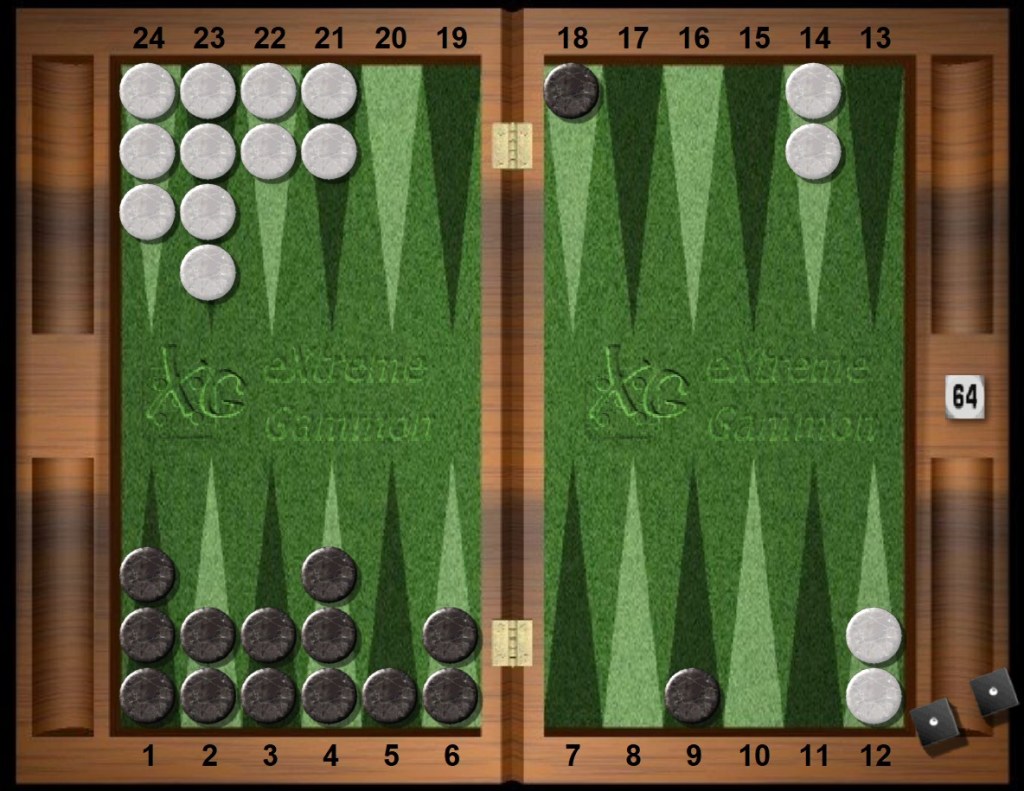
The first edict in the new world order is: Who has the racing lead? Mutual holding anchors lull the game pace into quietude. But after White’s miss, Black wonders whether running is the best bet? Here, at least, the pip count matters. First, what is the qualitative running lead? Just imagine matching Black and White 55s rolls and scurry the outfield checkers homewards, then see which checkers are left over where. Black seems to have about a half roll lead, and ready to toss the dice. As long as there is contact, a race this close does not require accurate pip counts.
Next edict, what are Black’s chances to break contact by fleeing? All are bureaucrats in the new world order, so all must count. Abacus clicking in every government office. Seventeen shots flee. Fortunately, all are upper class pips, thus helping the running plan.
Suppose Black waits to cube and the black runner takes flight into the black outfield. How does a double look to Black now? For example, perhaps Black rolls the smallest 43s, flees, and White too rolls 34s. White will pass Black’s impending cube. Thus, the lion’s share of Black’s market losers are embedded in those seventeen fleeing rolls. Black will have lost his market when White passes.
The corollary is the question: How can Black survive if unable to flee? White has a direct shot, and often a double direct. Of the flightless shots, only six leave a single direct and thirteen leave a double direct. That is about ten casualties in nineteen firings, and maybe one or two more should Black be missed then fail to escape.
If Black plausibly arrives on the bar, what then? Black has the stronger home board, a board that can easily contain a white dancer. With the white 5pt-6pt points open Black is a favorite to enter and spring out, perhaps even hitting a white outfield blot with a fly shot. This irksome scenario persists for White as long as Black dances. Fly shot, biting gnats.
Thus Black may have a cube. Neither White nor Black is likely to lose a gammon in this late position. White can close the black dancer out, but only for a roll. Hence no gammon. Black could someday hit a white blot with a fly shot and contain it, a remote parlay. Hence no gammon.
Conclusion: If a black checker is on the bar, White is a long way from a redouble.
About seventeen fleeing rolls are market losers, about half of the nineteen attacking shots miss the black blot, which escapes, plus a few fly shots. From this position Black likely wins two out of every three games played, on average.
Seems like a good first double. Without gammon prospects, the Jacoby rule is moot.
A close cube for Black is an easy take for White.
D/T
This situation is a reference position for a first double in a cash game. A benchmark position is any backgammon situation worth remembering. By contrast, a reference cube position for a double is any situation where it is the same equity to Double or Wait to double. Similarly, a reference take position is a situation where passing the cube loses the same amount of equity as taking the cube. Reference cube positions are a razor-thin dividing lines in a cube decision.
 the baron talks backgammon