Cube actions. Cash game. Jacoby rule in effect. White doubles. Does Black have enough of a position to take the cube?
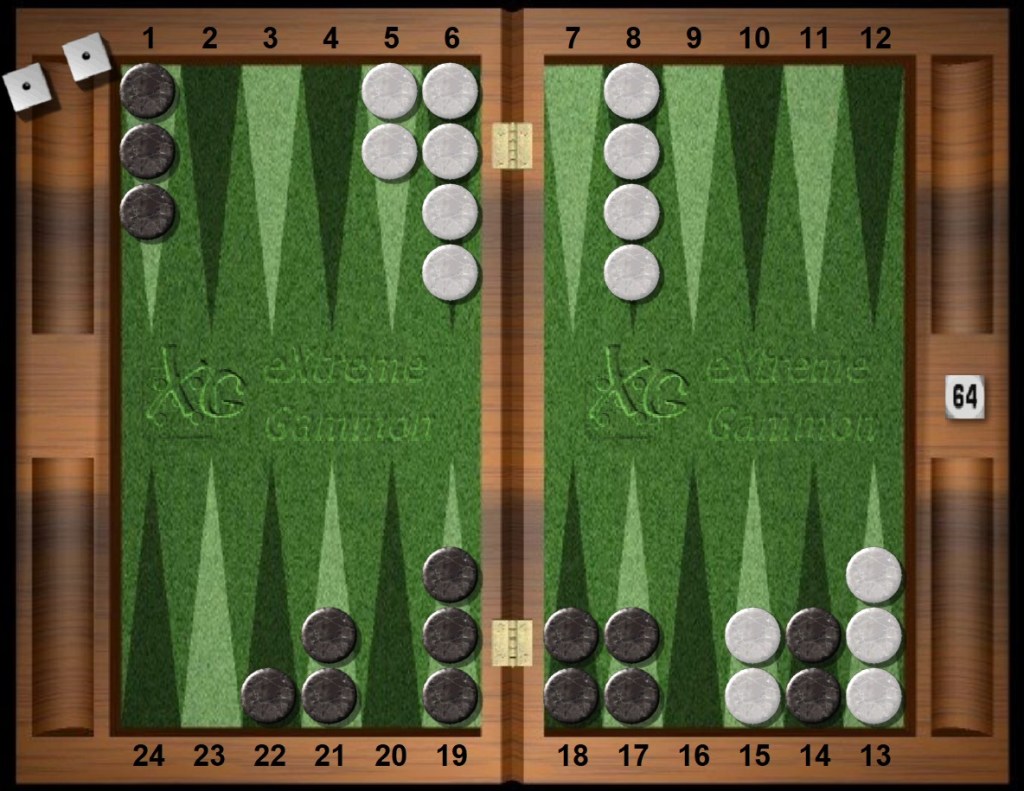
What does White have going for her in this position to offer a first cube? First, White has escaped both runners onto a comfortable 15pt, an achievement known as a Houdini position. The white 15pt is hardly challenged by Black, as Black has cleared his midpoint in exchange for his less effective 11pt. White has made her golden 5pt with well-balanced spares on the original 6pt and 8pt. White also has a spare on her midpoint, a valuable checker which gives White some time in most situations to choose when to break the outfield points. The midpoint spare gives White flexibility. With a black spare on the deep black anchor, White clearly leads in the race by about three rolls, including White’s toss of the dice after the white cube.
Black is not without resources. The black home board is almost as good as White’s and the black barpoint creates a formidable blockade, if only a hapless white checker is recaptured. Black’s position would be far worse if Black had no anchor, but Black still holds the 24pt anchor with a spare ready to seek contact. Black’s game plan is to recapture a white checker somehow and block its escape with a developing black prime. The spare on the black anchor provides time to bulk up the black prime and provides harassment during White’s leisurely scramble home. With most of White’s home board currently open, Black may even be happy to have his anchor spare hit on occasion as it sallies forth into an outfield controlled by White. Perhaps Black may upgrade the anchor to the 4pt or 7pt, thereby improve Black’s chances in any holding game, reset Black’s timing more imminently, and reduce Black’s gammon exposure.
White plans to lumber home quietly, safe as a church mouse. Gingerly Black plans to seek contact in a controlled way, starting with the deployment of the anchor spare. Both White and Black intend to cool the situation and take a longer view, hence the volatility of this position is quite low — less than half as volatile as the start of a new game.
White does have knockout punches. All doubles play well. Three other rolls make a key point without breaking. About half the other low dice combos help improve White’s prime. Should White make her barpoint soon and later extend her prime in either direction, then the black spare on the deep anchor portends a gammon loss for Black. That spare, still on the anchor or dancing on the bar, remains trapped. By contrast, Black is unlikely to gammon White. White can often milk the position by leaving no early weakness or voluntary blots. A late fly-shot loss of the game hardly involves a white gammon.
This position, therefore, has a curious combination of low volatility and seesaw gammon prospects — White often wins them though Black rarely does.
Rollouts show that whether Black takes or passes this cube from White, Black does the sad but correct thing. Black loses, on average, exactly one point by dropping or taking the cube. The position is a reference take point in a cash game. Examine the full ply of upcoming rolls of the dice — first White and then Black — and White already has a majority of rolls (52%) that are market losers. Therefore, White must double now.
If it does not matter financially in this position whether or not Black passes, should Black take the cube? Here is where gamesmanship enters. Black asks: Is White a distinctly weaker player than Black? If No, then Black should pass. Is White’s position difficult to play from here? Is the situation complicated or routine? If routine and easy to play, then Black should pass. When White is the less skillful player and the white position is complicated to play, then Black has a management decision: Is it a more lucrative use of time just to start an extra game in this session? Often it is, and Black should pass. Only when all these stars align and Black is certain the drop is a reference take point, then Black can take.
But usually Black should pass this cube.
 the baron talks backgammon