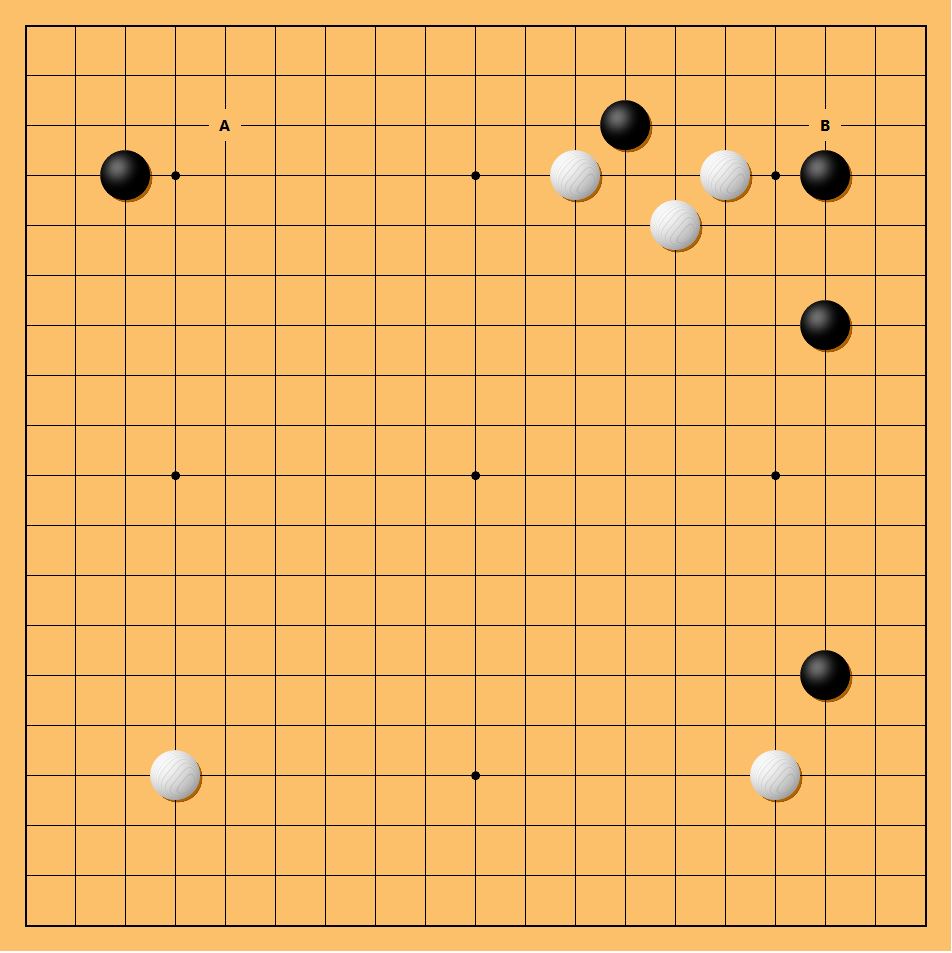
Black pauses to take stock of a faint signal coming from his sources of inspiration, mental beams of imagination, fragments of thoughts from Black’s subconscious, a chatter of ideas directed by that young prodigy he once was. In short, Black thinks.
By design, Black arranged for both komoku corners to open towards the top. In reply, White keeps the lateral symmetry of the Go board, and plays two star points at the bottom. Mirror of yin and yang ideas. Black approaches at the bottom right, the subject of the commentary. But White ignores it and approaches at the top right. White and Black outline a simple pincer fight.
Black takes stock of the remains of side-to-side symmetry and chooses to take territory. Black will play at A to enclose the NW corner. White will attach at B and usher Black, hand on sleeve, to bank more territory in the NE corner. Meanwhile, White builds a thick group of central stones.
White is a famous moyo master. Black is renown for his creative and flexible play. Both highly value beauty in Go. Studying in the same house as children, Takemiya and Otake know each other very well. Otake as Black will play along with White’s conquests for awhile. The pattern in the top right corner feels strangely familiar — a childhood delight.
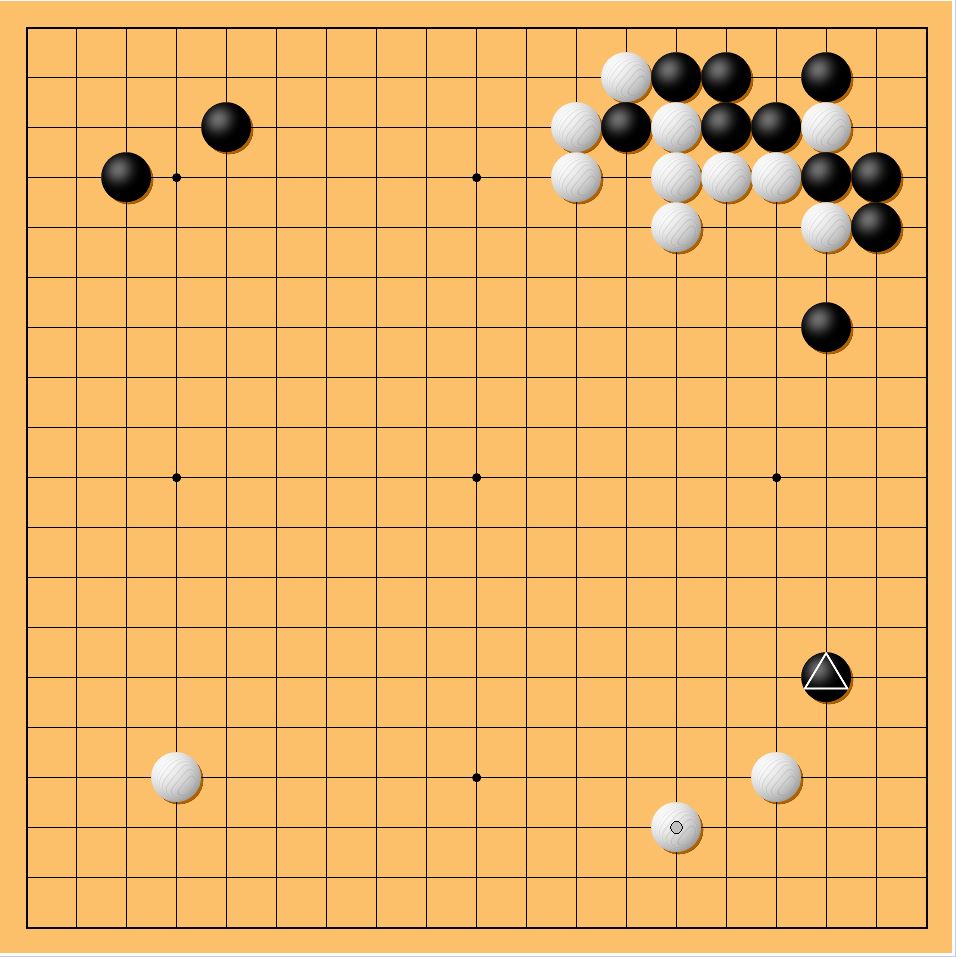
White slides toward the bottom. Why does White answer the black kakari at the bottom? Why not pincer it by invading the right side?
Foremost, White is backed by real thickness at the top. Powerful, fearsome white thickness. Thick stones, with both eye shape and a territorial claim at the top.
Black is solid, but not thick. Black has two solid territories, yet not much else.
“Stay away from friendly thickness.” An old man huddled in a late-night game at a crowded pub once spouted this prophesy of Go. He lived far away and centuries ago, but his wisdom is still true today. Stay away from thickness. Friend or foe.
A white pincer would split the right side, even demolish the side. Do either Black or White care? The right side is now swamp land, an area low and stunted of growth. Black expects no extra territory here. Too thin, vague. The logical consequence of Black’s greed for profit has run its course on the right. At least for now.
The white prospects behind the pincer, meaning the upper right, would already overlap the nearby white thickness at the top. As a plan, while White boasts, Black would quietly trim and prune around this overlap, hoping White will eventually shrivel into a void.
Not pincer, but answer then. Grow, says White, the great moyo monger. Blossom and grow. White answers the black kakari with a slide toward the other star point stone at the bottom.
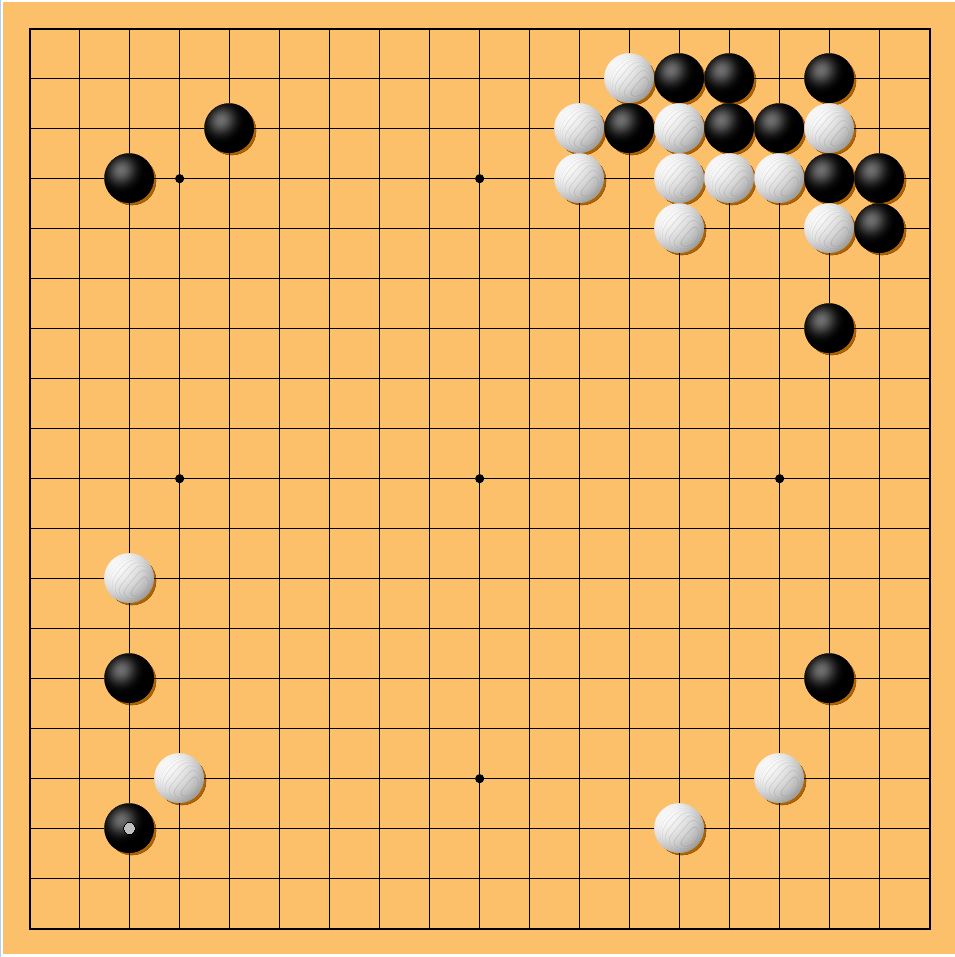
Black approaches from the strong and open left side.
White plays the tight and low pincer.
Black enters the corner.
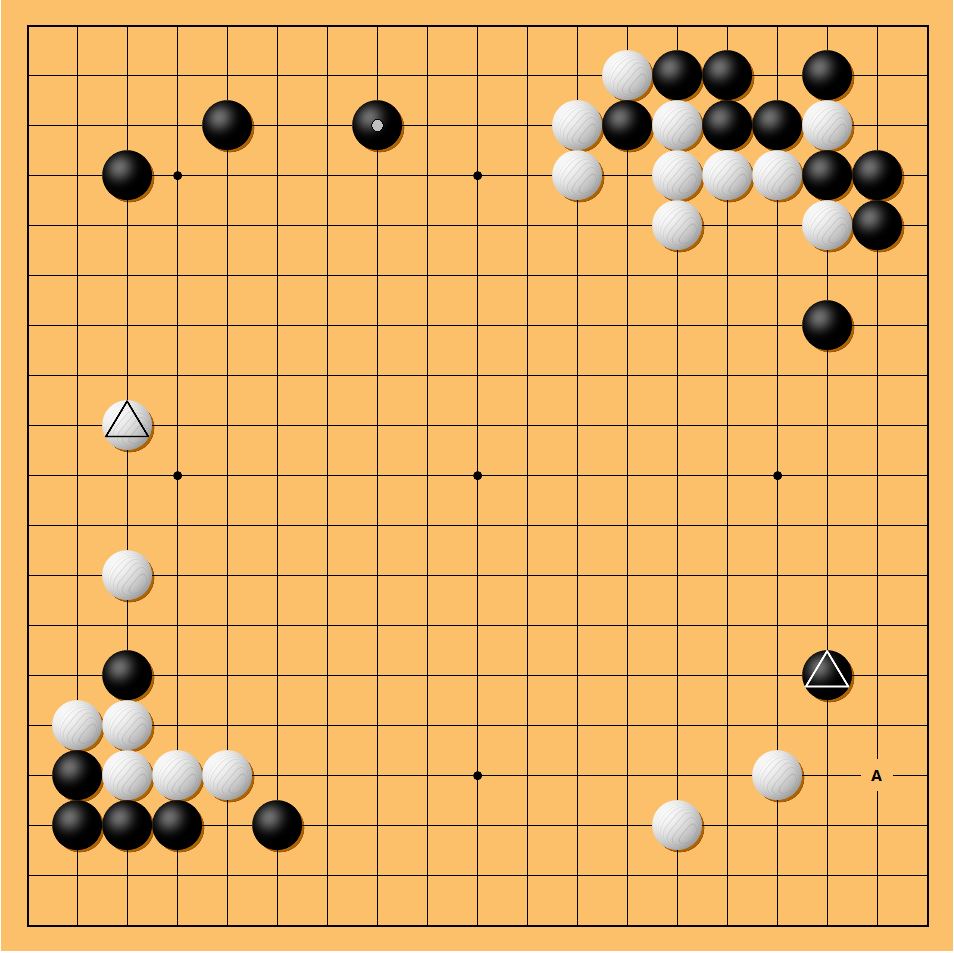
After the corner pattern, White expects and gets sente, and with it White makes the desirable extension into the solid fertile ground on the left, as marked. White thereby takes a superior opening point, coveted by both. Black takes the inferior extension at the top, gingerly reaching low and steady toward white thickness. White gets the better of the miai points.
Has White gained the initiative? White has sente and now two thick groups. If Black had a weak group somewhere, White would certainly attack with an invasion. But Black’s groups are all strong. The lone exception is the black kakari stone, marked.
Without targets to attack, and with thick central groups standing idle, White must gain profit by threats, and not with actions. White will play at A to chivy a response and to bank some territory. Hence White answers again at A.
 the baron talks backgammon