This is a short cash game with one actual checker play decision, and thereby one error. The choices are close in equity, so anyone could select one of the five sensible plays without losing respect.
Black opens with 61s and makes the bar.
White replies with 25s, splitting her backmen and moving a midpoint spare.
Black tosses boxcar 66s, and moves a pair of checkers to both barpoints.
White responds with 46s and makes the home 2pt. Finally some improvement.
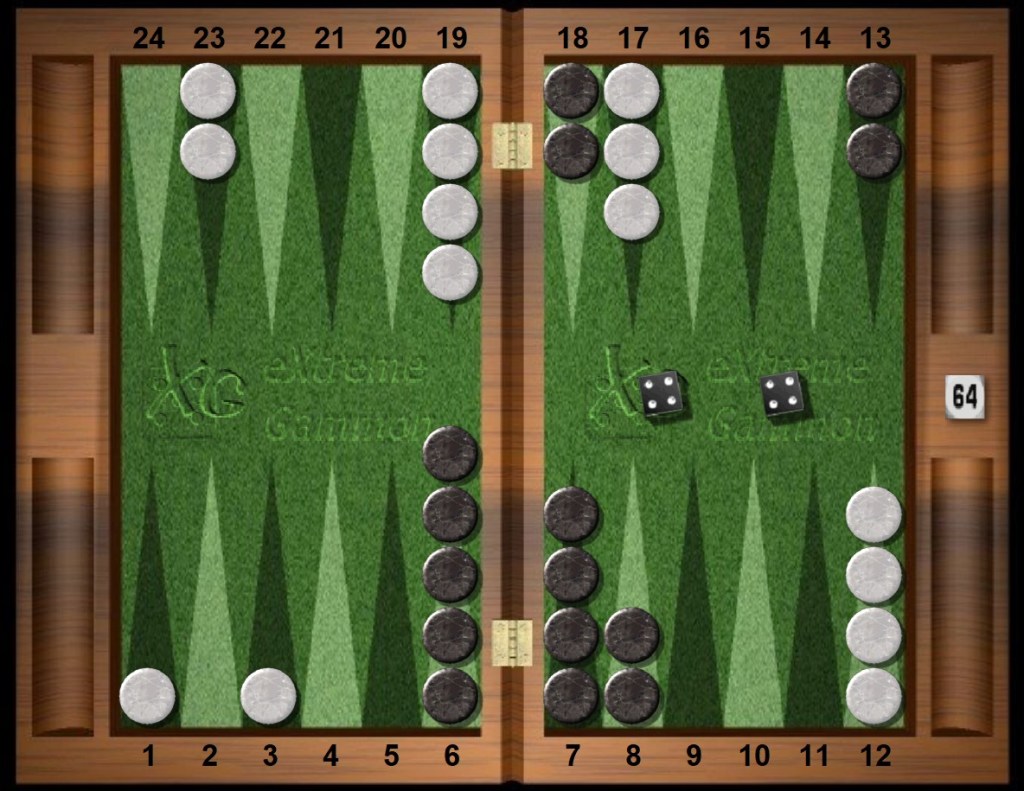
Black rolls another set of doubles, this time 44s. Here is the position: Black to play.
One theme in backgammon openings is: Keep Options Open.
And the fastest way to restrict options in an opening is to commit early to a single game plan. Balanced plays in flexible situations try to commit to more than one game plan, preferably all of running and blocking and attacking.
In this position, after Black’s monumental rolls of 66s then 44s, a racing lead is a guaranteed plan. Hence the game plan candidates are:
- race plus block with a dash of attacking
- race plus attack with a dash of blocking
- both attack and block in addition to running
The five candidate plays show nuances and trade-offs worthy of note. Two plays ignore the white blot and three plays attack it, hitting it onto the bar by pointing on the home 3pt .
Suppose Black ignores the white blot with this roll. Then Black can greatly improve his blocking structure by trailing with either the 14pt or the midpoint, and making an outfield blocking point. This play:
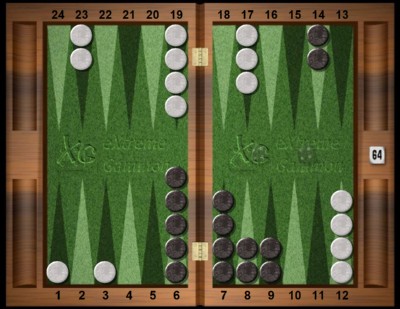
or this play:
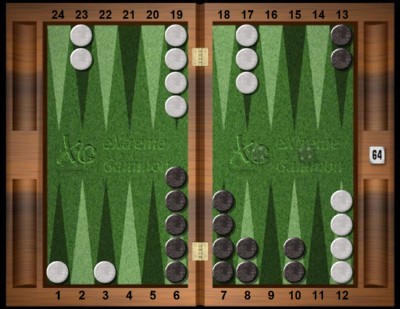
Of these two plays, which is better? Both the 14pt and the 13pt provide full outfield coverage should White run. A stripped 14pt is slightly harder to clear than a stripped midpoint, but so what? Not a priority yet. The detailed structure of Black’s blockade is the chief difference. Black has a solid 4-prime in one case and a broken 4-prime in the other. Often, the solid prime wins out. But not here.
White has split her backmen and soon could anchor well. This adds an element of urgency to Black’s developing prime. Black’s five builders on the 6pt and 7pt are awkwardly placed, top-heavy for any smooth mobility of the prime. No mystery there, after boxcars and double fours in the opening, Black’s crossover sixes often become difficult to play. After the solid 4-prime, using sixes to make a new home point can leave a direct shot at an outfield black blot; after the broken 4-prime advances, an exposed black blot would be a combo shot. That matters here, even if Black manages to converts his game plan into attack — by more fly shots.
In this situation the broken 4-prime of 18/10(2) is the better of the blot-ignored plays.
Suppose instead Black attacks immediately, pointing on the white blot on Black’s 3pt. Black can make a third home board point in two ways. Namely, also make the 2pt :
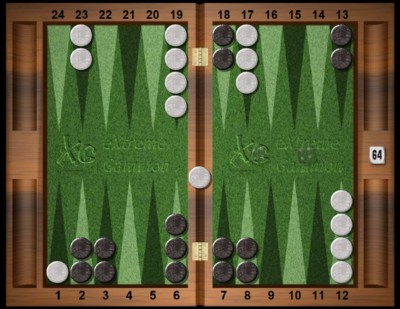
or also make the 4pt :
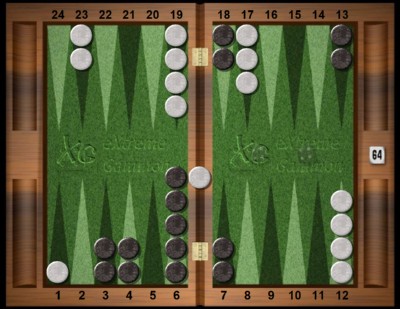
Selecting between a third home point, the home 4pt is obviously better than the 2pt: it is easier to gel into a 5-prime, it stunts White’s anchor locations, and it keeps the priming checkers within the same prime. Note: a made 2pt and a made 8pt cannot be in the same prime.
Instead of making the third home point, a balanced play advances the runners:
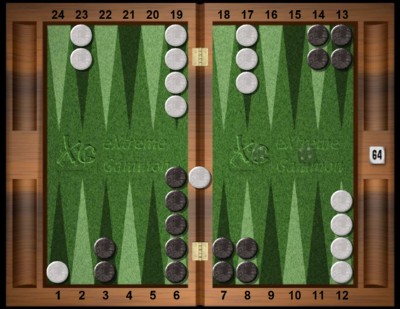
This play is less committed to full-scale attack, and in exchange ripens the run into a reality. True, the home board is less potent, but the outfield coverage of any fleeing white runner is enhanced. However, from White’s viewpoint, making an anchor from the bar is far more attractive than running away. White may gain a timing advantage with the anchor. Hence Black does not put all his eggs in one attacking basket.
The balanced run-attack is the best of the three plays that puts White on the bar.
Now the head-to-head contest. The main event. Fifteen rounds of boxing. In the ignore corner, not hitting a white blot, helping embarrassed sixes and ushering forward spares, plus keeping all of Black’s checkers within hailing distance, is the balanced running-blocking play of 18/10(2) with a dash of attacking threats. And in the hit-blot corner, mimicking an escape of the black runners, and making a new home point while putting a white blot in danger on the bar, is the balanced attacking-running play of 18/14(2) 7/3*(2) with a sleeping army behind waiting to block. Balanced game plan against balanced game plan.
Notice the threats are in a kind of balance too, an attacking threat of a blitz compared to a blocking threat of a prime. Usually, threatening to attack is more fearsome than threatening to block. Many doubling cubes, for example, are predicated on the threat of attack; fewer such cubes are based on threats of blockade. The time scales differ too. Attacks are more quickly resolved than building then suffocating with a prime. That may explain why the best play is 18/10(2) — winner by split decision in the fifteenth round and still a balanced champion play.
In the game Black chose the hit. White danced. Black doubled to cube White out.
Nothing to see here! Proceed to the egress.
P.T. Barnum
Backgammon. The hidden game.
 the baron talks backgammon