Has the old man has lost his marbles along with his ailing vision? Last night the old man quietly sidles up to third roll tosses of three-fours. Admit it. Too young. Too early. Hardly into the opening phase. Just the third roll from the blessed birth of a new game. And yet the 34s roll fascinates with its decolletage. In a chiral twist of nature the 43s roll breeds pythons. Beauty or beast? The seductive three-four behaves nothing like her prim sister, the four-three. Energetic and flighty, three-four jolts any game on a downhill path at breakneck speed. But the stodgy homebody four-three is ever planning, always building, later renovating a prim-and-proper prime to squeeze home a tiny advantage.
Okay. Far too flowery language. But last night the old man chatted with both sisters — both four-three and three-four — and discovered their charming differences. Many differences, which is the key point of interest. At the moment of birth of a new backgammon game, that first breath and that first roll, it is the toss of four-three that grants the most options. A quartet of good opening plays follow effortlessly from the toss of the twins 34s and 43s.
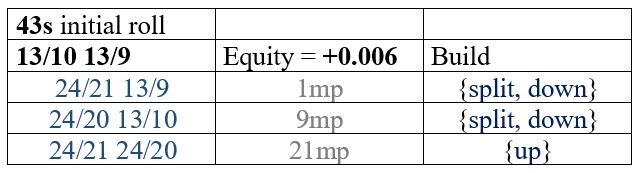
Long ago, when the old man had his marbles aglow, in a bygone era of the late 1970s, the roll 43s opens with two builders that unstack a bloated midpoint. Python unpacked. Flash forward a few decades. After all the bots in all the gin joints in Casablanca, the play of four-three-down still survives as the best play: 13/9 13/10. Apart from the six naturals as undisputed best plays {65s, 61s, 31s, 42s, 53s, and 62s}, the opening roll of 43s alone remembers the 1970s backgammon style and scene. The only peasant to survive. The other workaday rolls are off to modern tech jobs. Only four-three remains a craftsman. Steady and precise. Bring two builders down, then put up with those new age rolls chirping. Share a strategy meeting with three other opinions. Science and technology and business promote these three poseurs, insisting these opening 43s plays have some right to be at the table, ostensibly created equal in equity at the birth of this game, equal within two cents on the dollar anyway. No other opening roll has four creative options. Four characters, if you will.
The only dodgy opening is the middle east split, a play of 43s that thrusts both runners to challenge for both quality anchors: 24/21 24/20. This play promises thrills and spills, much dancing, secret imbroglios and plenty of hits. For that carnival atmosphere, a two percent baksheesh is levied for introductions and the privilege. The game will never be short of byzantine logic or stray far from a harem of delight. Worth thrice the price.
Like the twin sister rolls 34s and 43s, the opening split plays themselves of 24/21 13/9 and 24/20 13/10 seem joined at the hip. Each makes a stab at a high anchor and each prepares a surprise reveal on the home side of the backgammon board. Small details between the two splits are treasured by backgammon connoisseurs, both here and abroad.
Four legit opening plans. All equal equity, near as damn it. The most opening options permit the most flexible followups. Unsurprisingly.
How does the flexibility evolve on the third roll? Bring to the spotlight the play of four-three, after all the He-Said and She-Said, after Black plays his initial roll and White makes her opening reply. After introductions and the privilege. Now suppose Black tosses 34s. Then what?
Four-threes are team players. No question. Should White slot her own golden point with 12s, Black 43s will certainly hit with the four. Should White split to Black’s golden point with 45s, Black 34s will certainly hit loose on his golden point with the three.

Consider this position. Black opens with 61s and makes his barpoint. White replies with 11s by making both her barpoint and her golden point. Of course, Black 34s has the honour of hitting White’s trailing blot in the outfield. Four-threes are indeed team players.
Suppose Black opens with 61s, making his barpoint. Then White replies with 55s, moving freight to her 3pt. Black now rolls 43s.

With the beginnings of a black prime and White making a useful home board point with a racing roll, Black maintains his dedication: 13/10 13/9 down to continue building a blockade.
Suppose again Black opens with 61s, making his barpoint. Then White replies with 53s, making her 3pt. Black now rolls 43s.
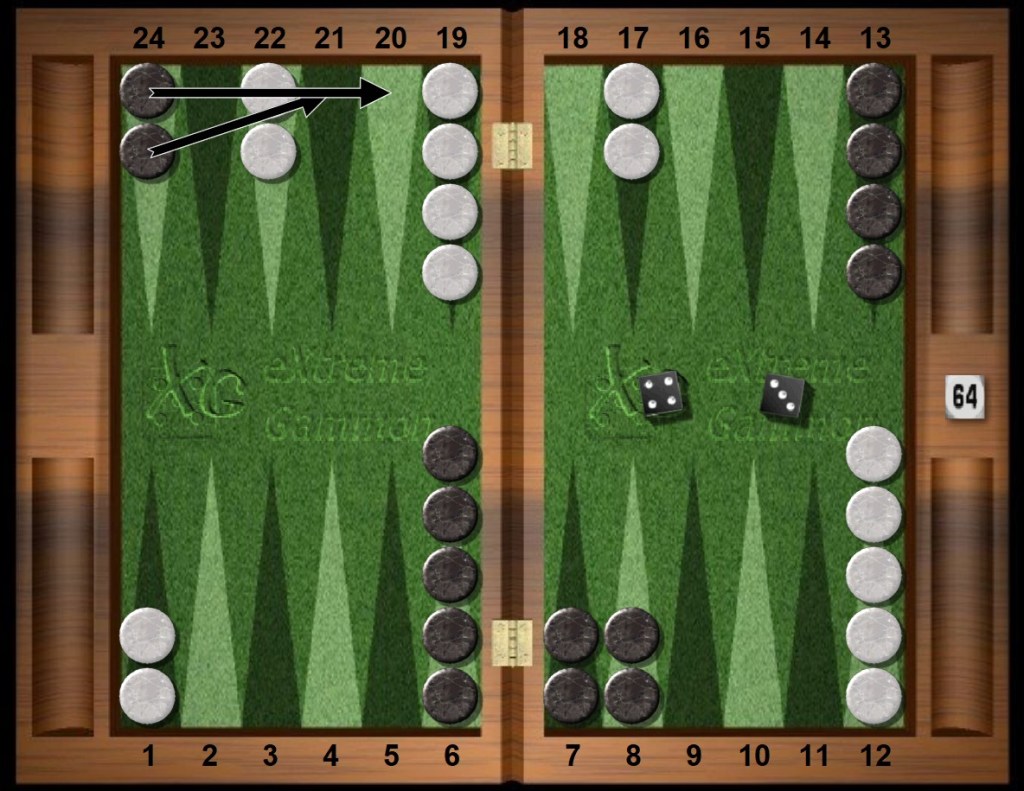
Black makes a grab for one of the high anchors. Structurally, this position in similar to the previous, but White has negligible racing lead and fewer attackers in the zone. Should Black succeed in anchoring, the white blockade is split and becomes awkward.
Suppose again Black opens with the 61s barpoint. White rolls 42s, making the home point. Then Black rolls 43s.

Black plays one of the minor splits, pulling down an outfield builder.
Suppose again Black opens with the 61s barpoint. White rolls 31s, making the golden point. Then Black rolls 43s.

Black makes the other minor split, right to the edge of White’s new golden point, and Black brings down a builder.
Suppose now Black rolls 61s and White rolls the same, 61s. Both make the barpoints. Black rolls 43s.
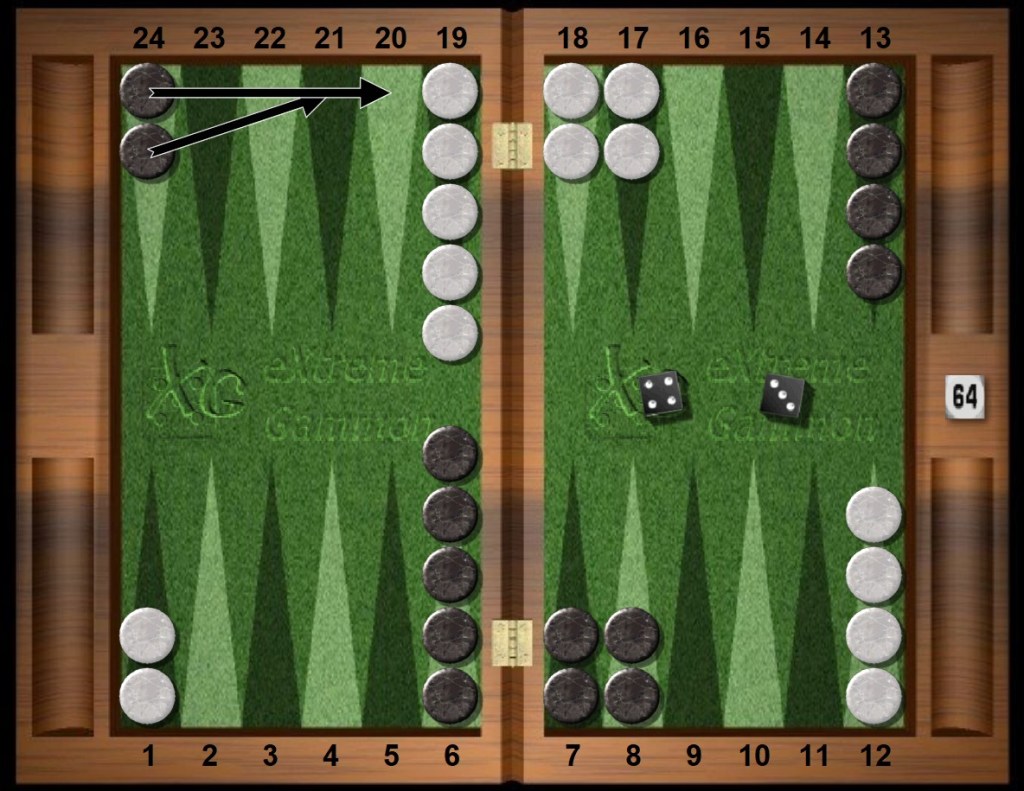
Without the additional point in White’s home board, Black can try the middle eastern grab to a high anchor.
Again Black opens with 61s, making the barpoint. White replies with 22s, making the standard 4pt and 11pt build and attack. Black rolls 43s.
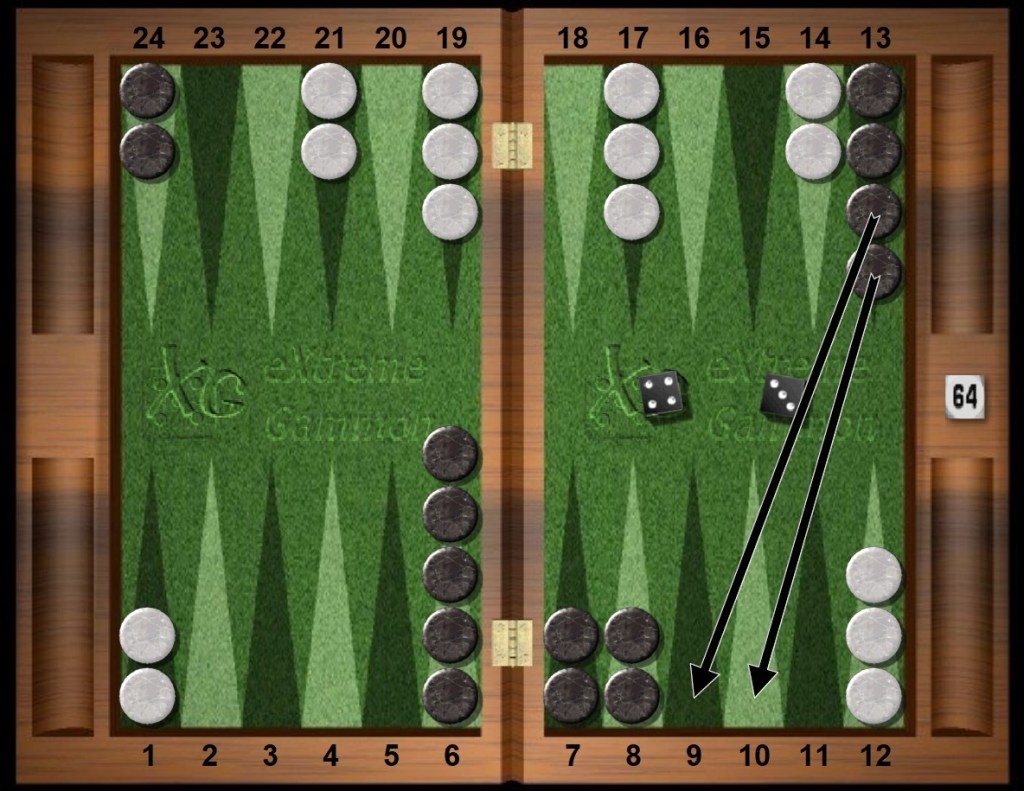
With the extra white checkers in the attacking zone, Black reverts to pulling two spares down from the midpoint as builders.
Black opens with 61s, making the barpoint. White rolls 64s, making her deuce point. Then Black rolls 43s.
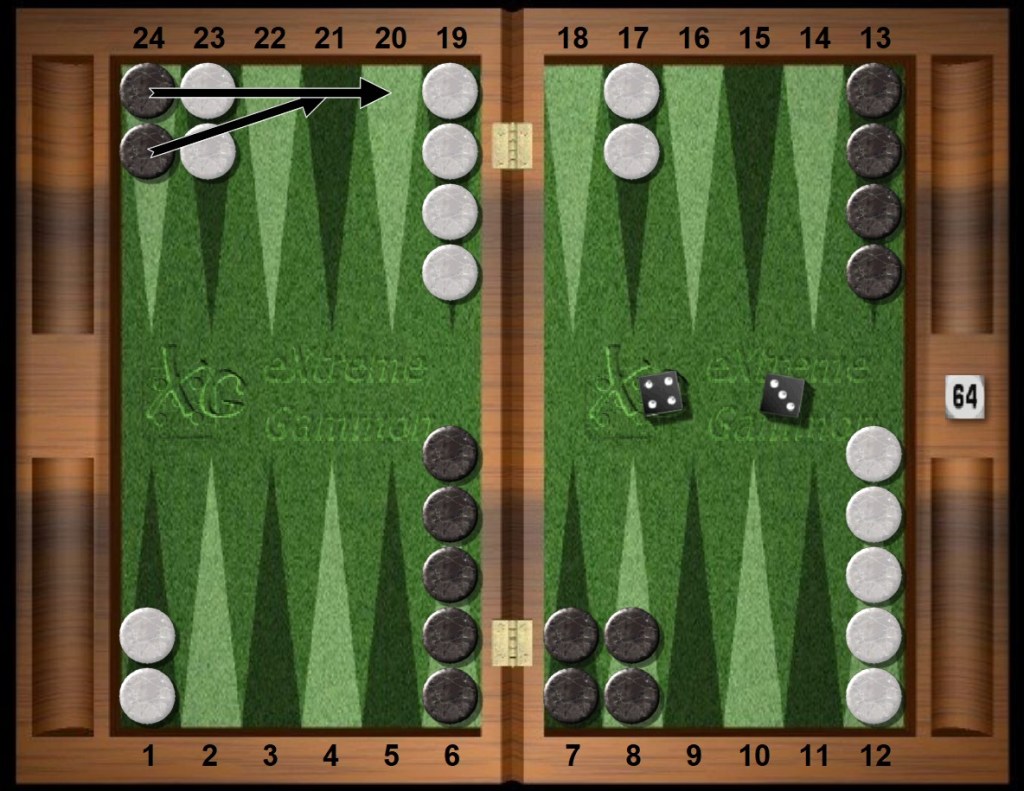
As with 53s before, Black again brings both runners up to start a high anchor. White has not increased the number of checkers in the attacking zone.
Knock yourself out. A piece of advice from the old man? To maintain a flexible state of mind in backgammon, you could do worse than practice the options from early rolls of four-threes.
 the baron talks backgammon