As a position to remember, this situation is fairly easy. In a cash game with a centered cube, White is on the roll.
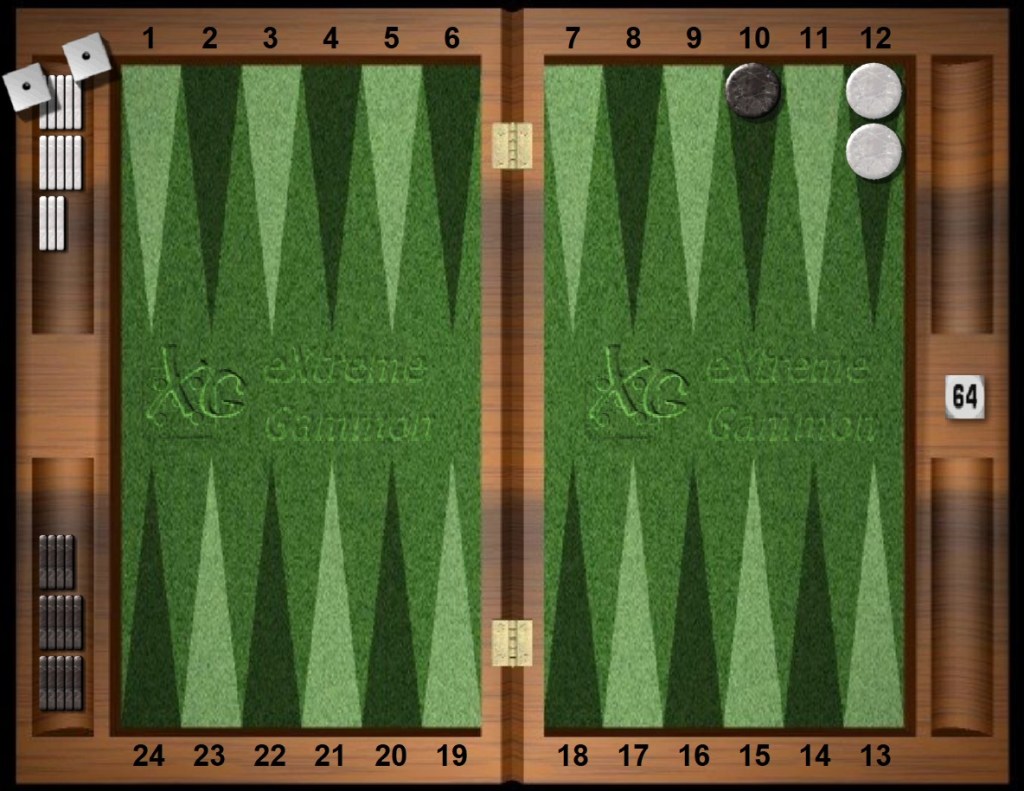
The contact boils down to the white outfield point perched on the other midpoint and an ogle of the vulnerable black blot on White’s side of the board.

Both players have closed their home boards.
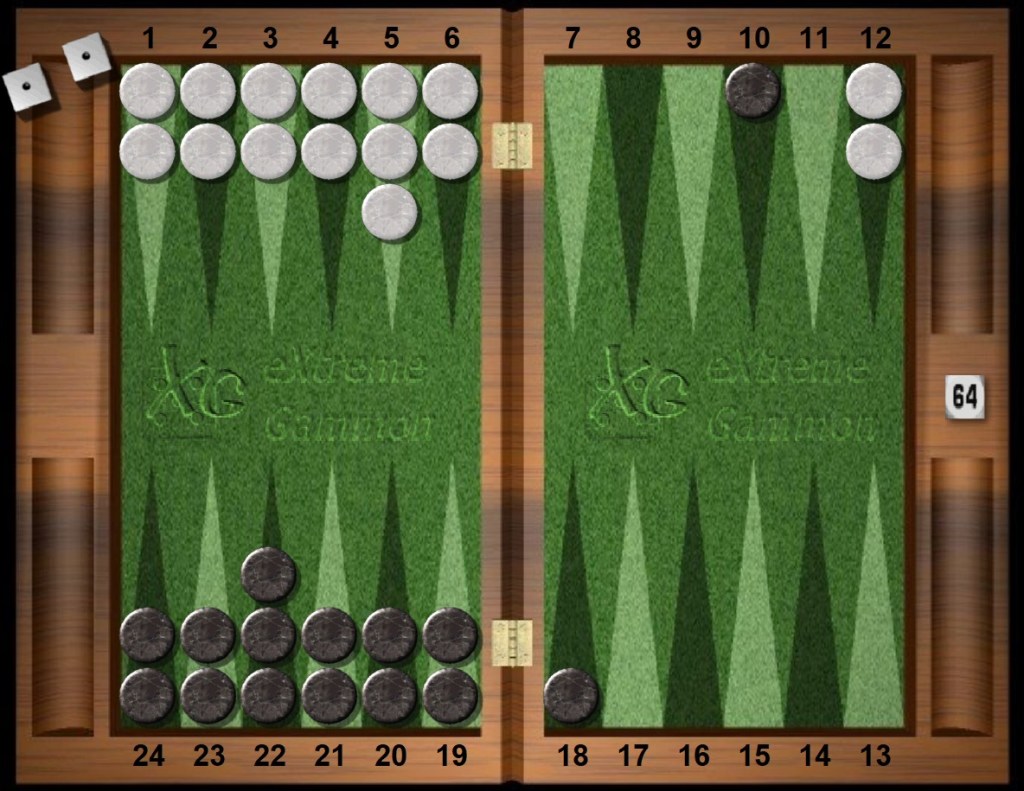
Although White is on the roll, Black has a half-roll lead in the race, exactly four pips. The spares are placed by memory and constrained visually by this pip lead. Therefore the running game is still important to both Black and White. To cross-check the setup, imagine the 22pt black spare shifted to the 20pt, matching White’s home board, and then the 10pt and the 18pt black spares shifted to make the 15pt, obviously with a four pip lead. That mental shift confirms the setup process from memory.
In backgammon the question of when to double and the question of when to take are not always difficult, but even easy decisions benefit from clear thinking.
With a four pip lead by Black but White on the roll, if White misses the black blot, then both White and Black would win half the bearoff races from this situation. Or thereabouts.
How often does White hit the black blot? All deuces plus snake eyes hit, or twelve shots, which is one-third of the upcoming dice rolls.
Hence one-in-three times Black will dance on a closed board and typically lose the game. But, when missed, Black can also lose the race. Add in half of the two-thirds time of a pure race when White will win the bearoff race. White’s winning chances from here are thus one-third plus half of two-thirds, equals 2/3 total.
From the other point of view, Black wins by being missed (2/3) and then winning the race half the time (1/2), or 2/3*1/2=1/3 as a parlay.
Lip service to tiny corrections include: first, there are essential no gammons to be had by either side so the vague definition of wins is quite meaningful and second, White’s next roll that misses will itself be slightly above average in pips because White hits with low dice on average using deuces or snake eyes.
White 2/3 and Black 1/3: Easy double, easy take.
A correction for the purist number crunchers: the average backgammon roll is 49/6 pips. Hence with 36 dice rolls, the totality of pips up for grabs is (50-1)*6 per all 36 rolls. The total pips used to “hit” the white blot is the roll 11s (4 pips) plus the roll 22s (8 pips) plus the rolls 2*(3+5+6+7+8) or a total of 70 pips. Thus the average roll for White that does not hit the black blot has a grand pip tally of (300 – 6 – 70), but spread over only 24 rolls to average 224/24, or nine and a third pips per next roll only when missed.
This tiny correction in racing edge for White is a bit more than 1% extra, or White game winning chances are about 68% and Black game winning chances are about 32%.
Again: Easy double, easy take.
The game continued. White missed the black blot after rolling 36s, a subtle tip of the hat to the temporary average roll of nine pips. Black rolled 53s, another obvious tip of the hat to the official average roll of eight pips. Then White rolls 26s and Black rolls 54s, flipping the previous pip advantage as the bearoff starts. In a pure race, keeping a running tally of the difference in pip counts is often helpful. Back to the half roll of four pips. White rolls 33s and Black rolls 52s, both removing the maximum number of checkers into the bathtub. White now has one more checker off. White 46s then Black 21s continue the trend of more pips ahead and an extra checker off for White. White rolls 26s, two more checkers off.
Now Black rolls boxcars: 66s. Black gets ahead with one more checker off.
White rolls 25s, matching Black’s ninth checker off. White correctly plays both checkers from her stacked 5pt, and does not fill the 2pt gap by gapping her 4pt.
This is the current position. Black on the roll. Black owns the cube.
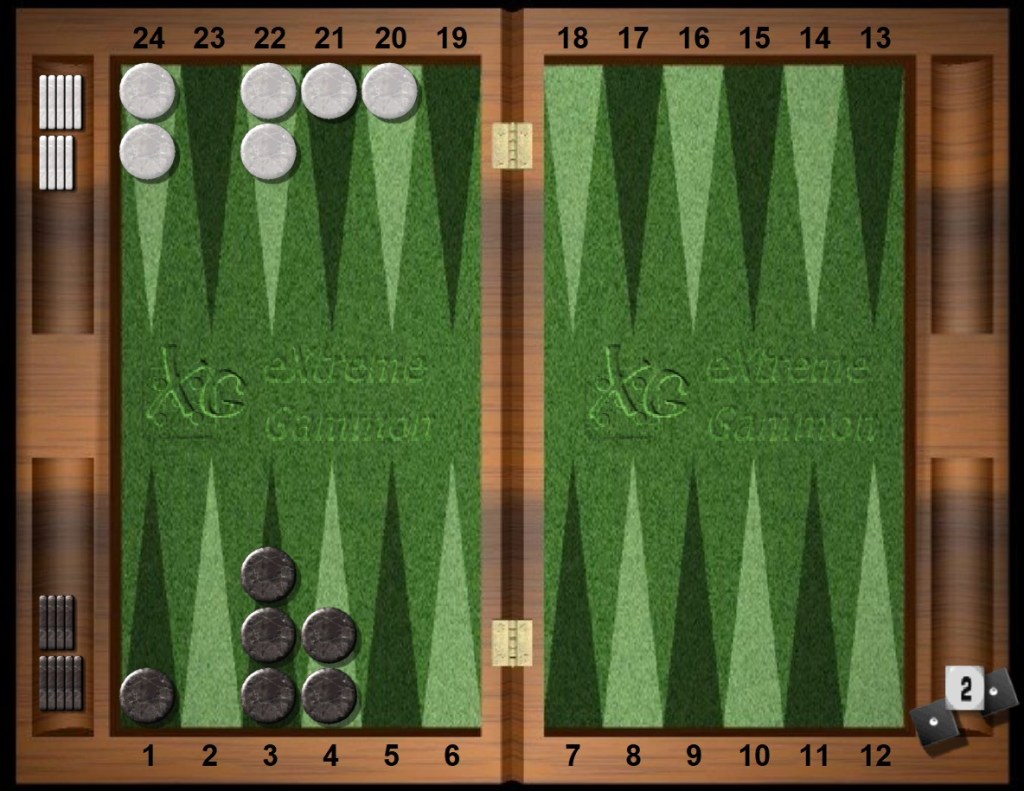
The redouble position has its own charm. By shifting the spare ahead to the acepoint and a 4pt checker back to the 5pt, it is easy to see that Black trails by one pip in the late bearoff. However, Black is on the roll and owns the cube. Does Black have a redouble? Does White have a take?
Both Black and White have nine checkers off and both have a deuce point gap. High doubles on the dice finish most resistance. Of course, exact numbers on the dice determine the truth, but evaluating the number of rolls to accomplish a specific task is the language of cube actions here.
Here is a secret to cube actions in the late bearoff after a joker set of doubles is tossed on the dice. Consider the Take/Pass question first and use benchmark positions to guide the decision. A benchmark position is any memorable position that informs one key idea. Here the three benchmark positions are: six black checkers on his 1pt and six white checkers on her 1pt is R/P; four black checkers on his 1pt and two black checkers on his 2pt, and White the same position is R/P; and finally two black checkers on the 1pt, 2pt, and 3pt with White the same position is R/P. But when gaps start to enter these benchmarks, then the take becomes possible.
Here, Black redoubles and White takes.
 the baron talks backgammon