As a recent Nebula video explains, effective practice is specific and purposeful. It is not merely diddling about. One key to effective practice is intent: find understanding through observing mastery, then pick apart the fundamentals of that mastery, and creatively imitate those ideas during play. Imitation is the sincerest form of flattery. Just ask any guitar player about his solos: he steals from everyone.
Black opens with the roll 52s.

Black plays the minor split to the 22pt and brings a midpoint spare onto the 8pt and into the attacking zone.
In the 1970s this minor split was discouraged, primarily using the argument that White double 55s crush the black runners onto the bar, blitzed or threatened so, both black checkers dancing, then cube action, and the brief game recorded in the history books.
In the 1970s openings, bringing down another builder as a blot on the 11pt was considered best, with the unhinged thought of boldly slotting the black 4pt as second best, and the current minor split a distant third choice.
Nowadays, splitting to the 22pt is the preferred opening play. The extra builder blot on the 11pt is still a playable opening for Black (acceptable within a penny of equity).

White also replies with the roll 25s. Both making the minor split and bringing down the builder blot are acceptable, but the better play now (to within a penny in equity) is the 11pt builder, returning to old school backgammon style.
White chooses the 11pt builder because a split black runner is vulnerable to attack soon rather than a reckless twin hit now. A downside of the 11pt white blot after Black’s split opening is Black hits with six shots instead of two shots.

With the roll of 43s, Black makes a small mistake. Although not under the gun from the white blot, Black’s uptown split is tainted by White’s extra builders in the zone and by a new stray blot in the black outfield. The stray blot suffers by introducing two game plans where only one is currently advisable. It gives White an entirely new way to improve her position. This play is a four cent error.
The correct run to the 15pt leaves threes and ones partly duplicated for White’s next toss. And a black blot hit in White’s outfield allows several combinations for Black to anchor on entry from the bar anyway. Further, Black has fewer blots, and hence courting fewer gammon losses.
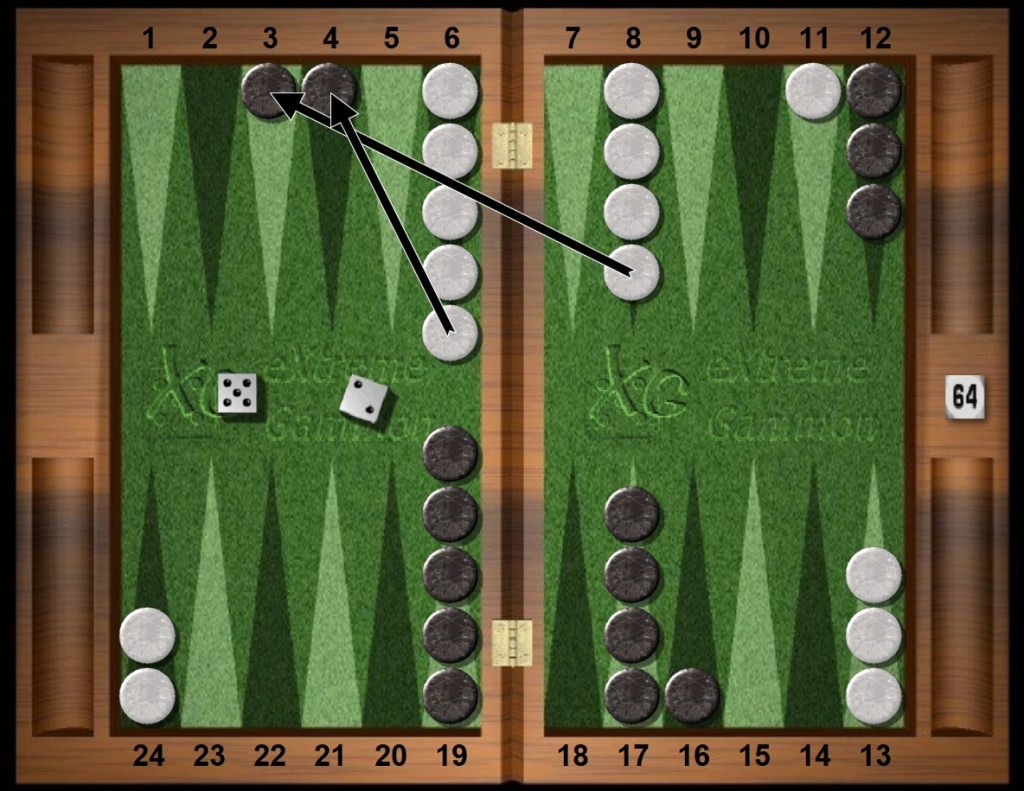
After the uptown split, White continues with the quirky profusion of 25s rolls in this quirky game. Twin hit of both black runners, a play of courage and daring now ratified by White’s additional attackers in the zone, unlike her previous roll.

Black now replies with a second 52s roll in the early opening. Forced entry from the bar. Misses the white blots completely.

White rolls the monster double 55s, the bane of the original black minor split. But here, White is all dressed up and nowhere to go … All that white firepower awaiting an attack order that never comes.
To recap this game, Black and White exchange rolls of 52s, then Black intersperses his flawed play of the 43s roll between another pair of 25s rolls, first White plays and then Black plays. White hits loose on two black blots inside White’s home board. Black enters but misses with the thematic roll 52s. White rolls a monster 55s, but fails to launch an attack.

No counting is needed. Now Black evens the pip count with his toss of double 55s. Black runs entirely into the black outfield. Game plans are in balance, yang and yin, Black running and White building and waiting, with no one in control of this game yet.
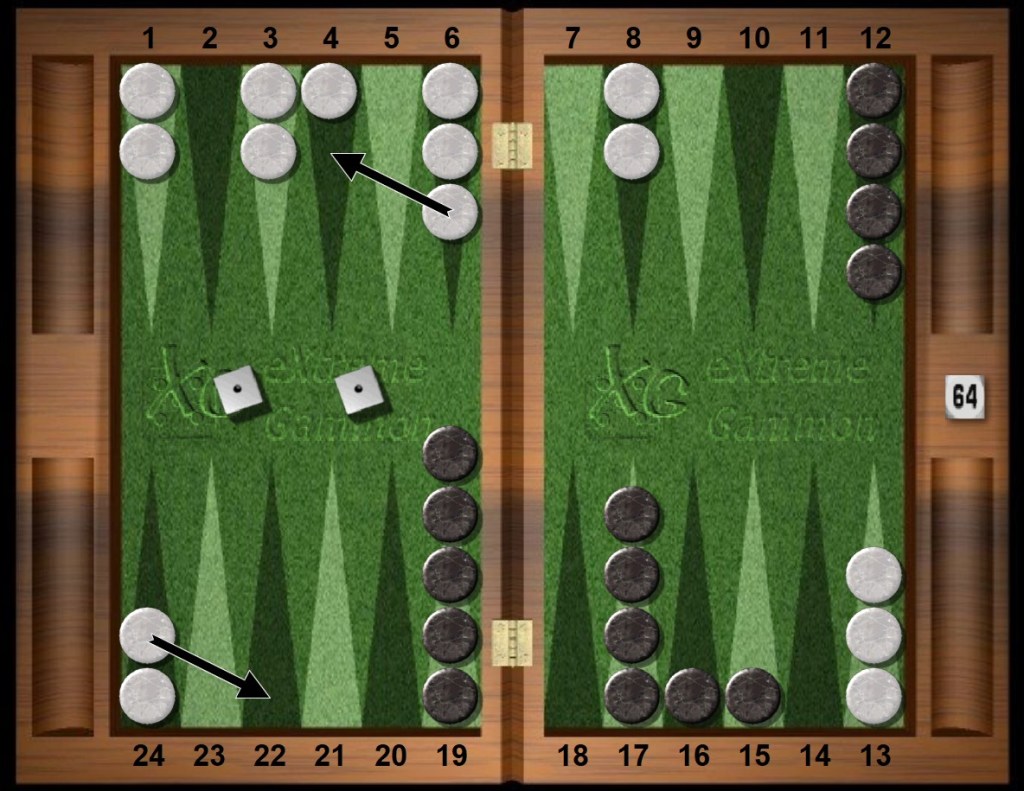
White double 11s. A delightful addition to any construction company. White covers her home 4pt and splits her backmen, challenging Black to a duel at dawn. The demarcation of game plans could hardly be more stark. After this small but mighty roll the pip count suggests the race is equal as a game plan. Hence Black must view attacking and blocking as preferable, yet keep his running game in reserve. A surgical attack when natural, but maintain a close race otherwise.

Black has positive equity but it is too early to offer a first double. It is rarely right to double on the mere threat of a blitz alone. Black needs another home board point or two as assets before a cube. White’s home board deters Black’s aggression.
Black attacks with the roll 53s, pointing on the head of White’s forward runner. Black rises to White’s challenge, though relatively safely.

White rolls 25s yet again. White has four sensible plays and chooses to enter high but is very vulnerable. White brings down the midpoint spare aimed safely at her golden point.
Entering on the 23pt is a three cent error. Yes, it is safer but a blockade works well for Black since the black midpoint functions as timing and attacking, but not as a landing post. White must be bold and try to grab a high anchor which, if successful, would benefit a late running game when White tosses good dice.

Black rolls 51s. Hit. Point. And roll a developing prime home. The blitz is nigh.
White should not be upset, nor second guess a low entry from the bar. White would be less upset on the black deuce point, but still in hot water.

Deadly dance.
End of Conversation.
The Classic. Point. Dance. And cube.
D/P
A quirky five-twos game, speckled with other ideas.
Imitation is the sincerest form of flattery that mediocrity can pay to greatness.
Oscar Wilde
There is nothing profound in this simple game, but the concept of the annotated story line, an intent that focusses on fundamental features of the story, and a note-to-self about those stolen solos sweetly strummed in future games.
The practicing of a game.
 the baron talks backgammon
Sure, nothing profound, but poetically produced as always.
LikeLike