Black opens with 32s and tries an old school play that brings two spares down from the midpoint, hoping to develop a blockade. Seven white rolls can hit.
W36s One of the seven rolls that hit a black blot.
B62s Black enters from the bar and slots the 5pt, hoping White misses. Starting the 18pt bar point is fine too.

W12s An interesting idea. White leaves the 15pt white blot alone and puts a builder on the 10pt to cover all the tables. From home board to outfield then around to the runner, White covers all of Black’s options.
B41s Making the 4pt seems a bit pedantic. Black wants to heat things up with the one to cover the golden point and the four to split as a trio of black henchmen.
W56s White has some running prospects but needs outposts and home points to stabilize the escape. Lovers leap to the midpoint is a blunder. Instead White stops at the bar and covers the 15pt.

B21s Pick and pass to refine the 5pt spare is slightly better. This move seems quiet, but also seems to recognize early that a blitz might blow White off the board, likely by the threat and the cube.
With 21s, Black chooses to leave the barpoint slotted and shift the midpoint spare to the 11pt as an additional cover for the barpoint. Small error.
W36s White enters and skips to the outfield.
B64s Black clears the midpoint, hitting the white blot. Five black blots are now scattered about but White is on the bar.
W23s Blot management. Deal with only one white blot.
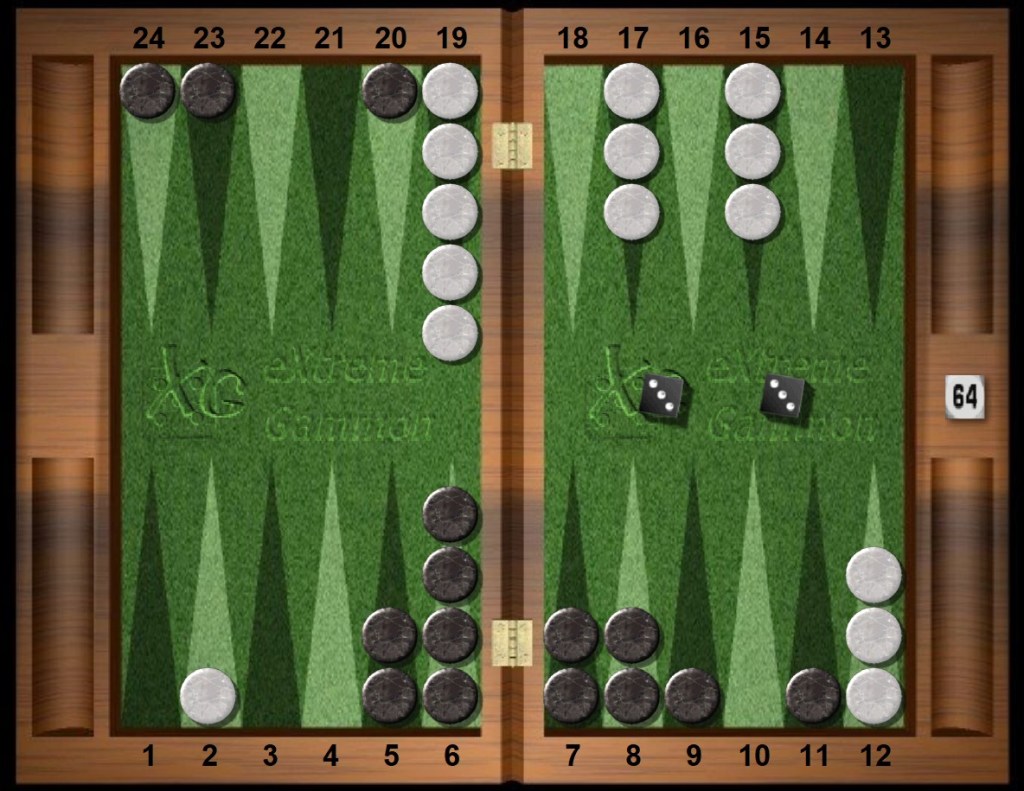
Black rolls double 33s, the first toss of doubles on the dice by either player. Always take time to consider the options. Black makes a big error in selection caused by not simplifying the selection list to three choices and further by not restricting the selection to the play of the last three on the dice.
Roll doubles, sweet boxcars, sweet mickeys, well rounded 44s, and the turbulent 33s, roll them and flatter them then distill the choices to the top three plays, as written by that wordsmith and seductress, Lady Luck.
Each of the top three plays will make the home 3pt in Black’s board.
Each of them anchor defiantly on the golden anchor, the 20pt.
The list only needs to consider the placement of the fourth black checker. Namely,
- Deep 24pt blot, perfectly safe 11pt outfield attacker, and 6pt home spare
- Advanced yet vulnerable 21pt blot, perfectly safe 11pt outfield attacker, and 9pt outfield blot which is not a full-fledged builder and could be hit by a fly shot.
- Deep 24pt blot, 9pt builder blot, and spare on frozen 8pt.
The best play is now obvious: the 24pt and the 11pt black blots are as safe as possible and the home 6pt spare is ready to attack.

The other two plays are serious mistakes.

And:
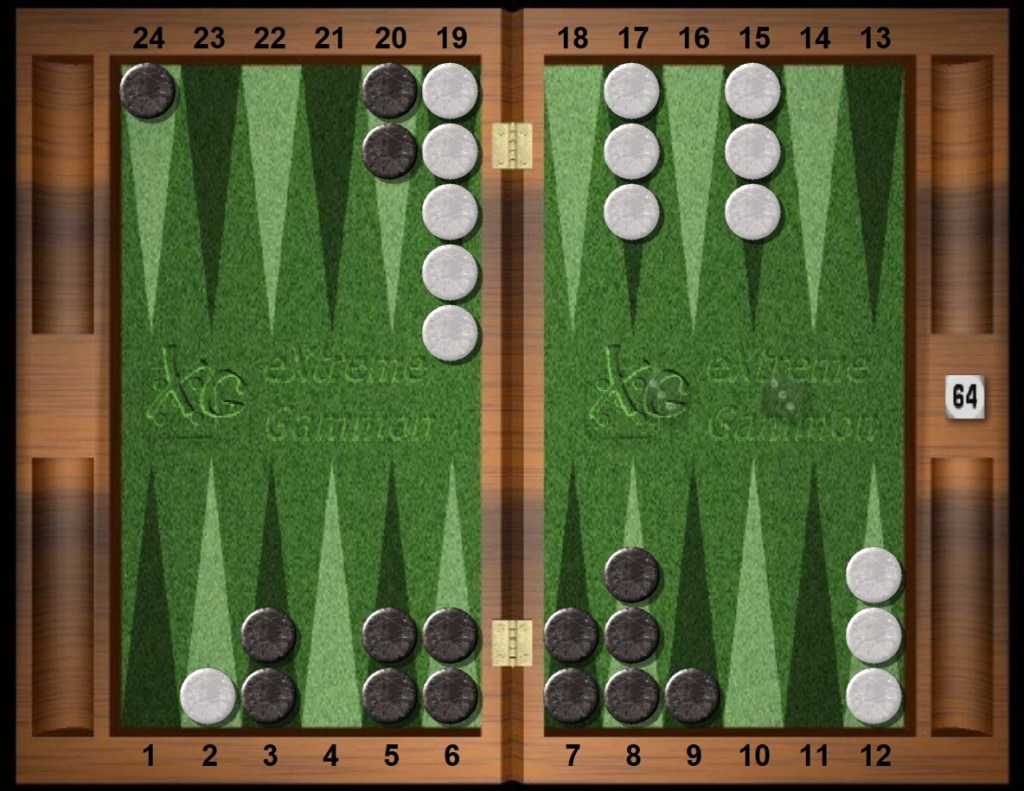
Black chooses the above play — a blunder.
Make a list, check it thrice, see which ones are naughty, and find which one is nice.
W34s Still trapped, White shifts the midpoint spare safely to the 6pt.

Black fails to offer a first double, a mistake of about four-cents-on-the-dollar.
Instead, Black rolls 21s and brings his outfield blot home to the 6pt.
W36s White is still trapped but makes her barpoint, leaving Black with only three 8s to hit.

Now Black wakes up about the cube and doubles. As it turns out, the position is a reference first cube for Black.
Try to learn something from this cube transition. In other words, cubing after the mistake of not cubing.
Amusingly, Black walks ass-backward with his missed cube into the later reference cube. The confusion benefits by having that late double on a razor thin line.

The game continues without incident (or error) until the above position. Black to play double 22s.
Here is the backgammon equivalent of Chess Blindness.
How to fix it? Again, make a list of plays and compare features.
In the game Black clears the 8pt, hitting loose on the deuce point. A blunder. The correct play safely makes both the ace point and the deuce point, hitting.
W23s White enters from the bar and hits both black blots, one loose in her home and one poised on the edge of the breaking prime, yearning to escape.
B52s Only one dancer enters, and misses the white blot.
White’s outlook for this game has rejuvenated into positive equity, but it would be manic for White to recube yet.
W26s White escapes the blockade and covers the home blot.
B42s Black dances.
White now has no problems to endure. White owns the cube. Play on to see if White can puff up her gammons by the next roll. White tosses 26s but stops on the 11pt.
B53s Black anchors from the bar and makes a crossover home.

An obvious redouble. The new anchor causes Black’s gammon peril to plummet. Now neither side will likely be gammoned.
Black is trailing in the race by about five rolls, counting the upcoming toss. That is a huge odds to ignore, especially as there are no gammons to be had here. Just hitting and winning occurs with dice totals of four and below for White, a mere 11s, 12s, 13s or five shots, followed by a direct to hit, maybe a dozen shots for Black. That combo is small potatoes. But then to hit, aye, there’s the rub, for in that hit of death the black home board has begun its decline with only two black blots facing one white blot in the outfield. When the empire falls, the outskirts sing.
White blotting is five shots and Black hitting is perhaps twelve shots, and this white straggler is about even money to escape from the bar and scamper on home.
Overall, the recube is a drop. Not enough chances for Black. Black passes the recube.
 the baron talks backgammon