Short games can sparkle in miniature. Such jewels are easier to recall, and focus on a single idea or two. Here is an example:
White opens with 35s and makes her home 3pt. The natural play.
Black replies with double 22s and also makes the natural play, his 4pt and his 11pt. Lucky to roll doubles on the very first toss for Black.
White rolls 24s, again a natural, and makes her 4pt creating a strong home board with three points already.
Black glances at the doubling cube, and observes both White and Black are developing well. Far too early for any cube action.
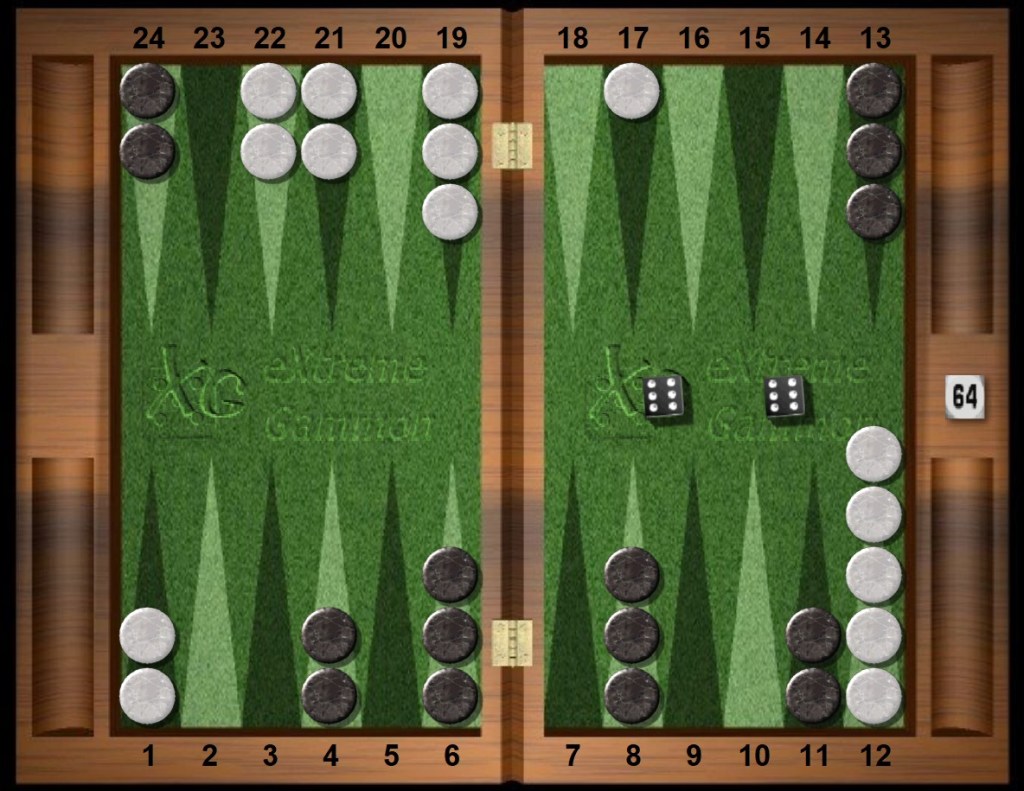
Black rolls boxcar 66s, another powerful toss of the dice. The defensive bar 18pt, the blocking bar 7pt, and the home golden 5pt — two of three key points can be made but not the third. The full blockade or both bar points are tempting, but the defensive 18pt and the attacking 5pt is very correct. The home gap fills at the expense of an outfield gap in the prime. Black’s third home point, the holy trinity, is needed to counter White’s strong home board.
Black has a slight edge in equity when the boxcar 66s tumble out of his dice cup.
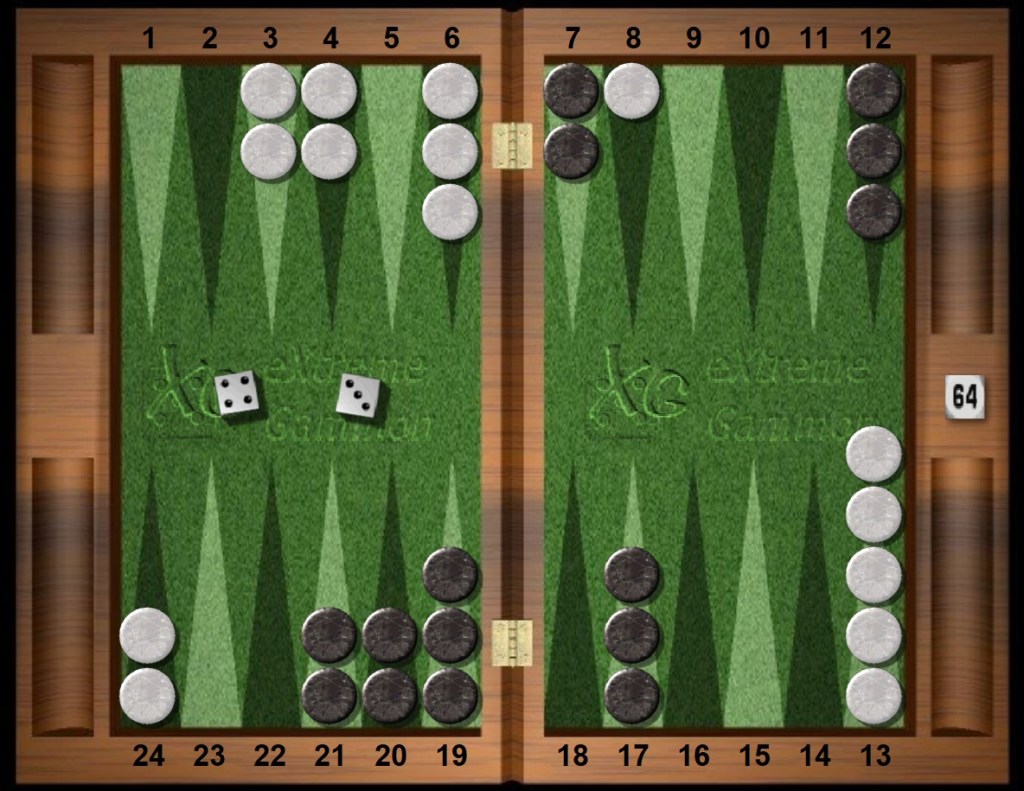
White rolls 34s. White is in hurry up offence and needs to grab a better home board. Slotting is fastest, slotting is in perennial use in backgammon, but here it comes almost cost free for White, as White must leave an outfield blot anyway in most variations.
Black again glances at the doubling cube.
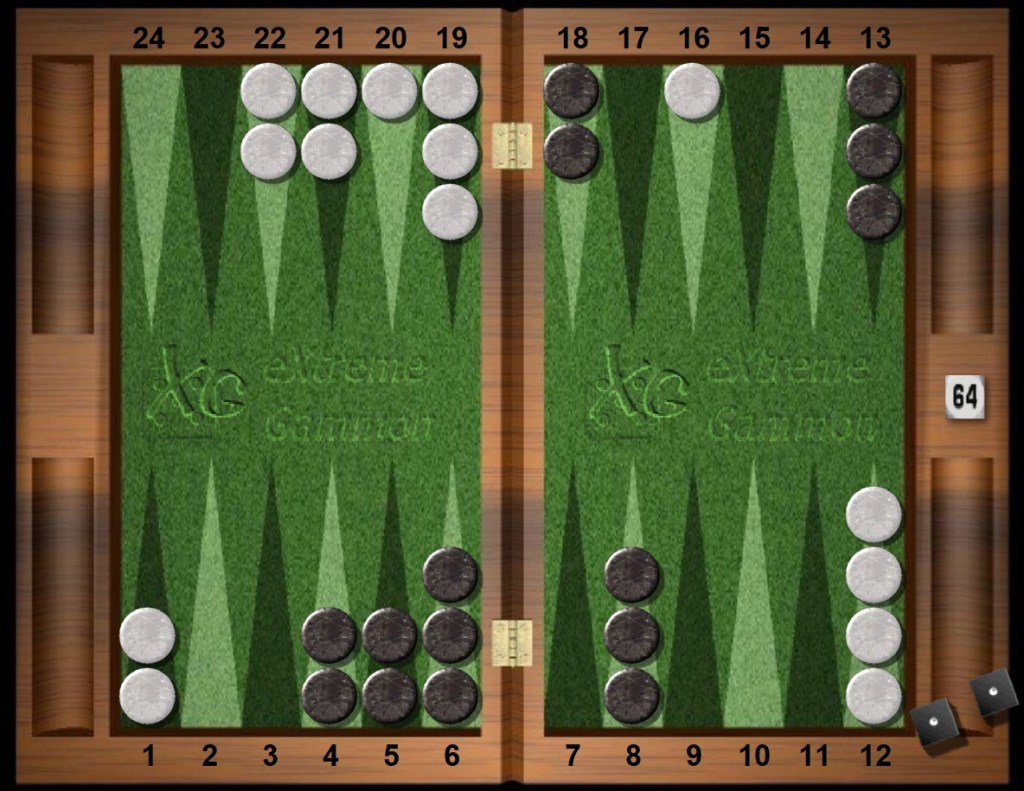
Black rolls a second toss of boxcar 66s. Black clears the midpoint to make the blocking 7pt along with a spare and then slots his deuce point, a location where White’s hit requires an indirect escape from Black’s menacing prime.
White rolls 13s. Hitting the black home blot is not even on the radar. White makes her 5pt and presents a massive home board. But it is too late.
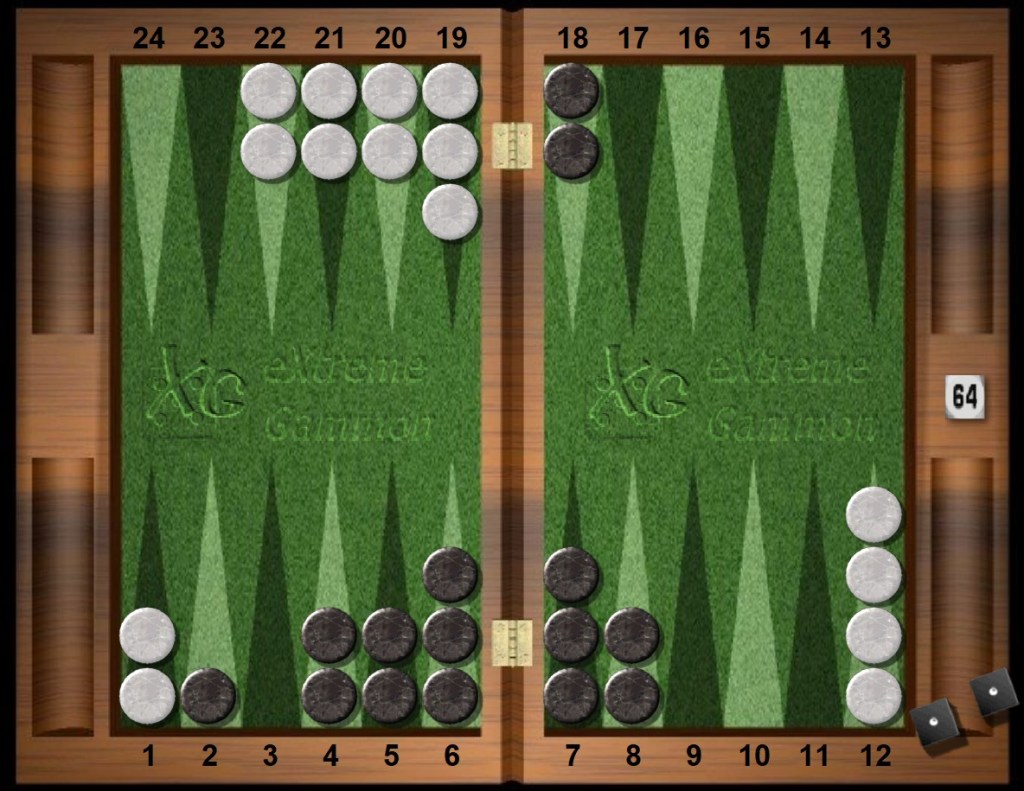
Black glances at the doubling cube. Black doubles. White passes.
And that is that.
In this game Black only rolls doubles on the dice: a trio of 22s, 66s, and finally 66s. Seven rolls in the game and neither White nor Black has made a checker play error.
But, with his glances, Black has blundered.
Back-to-back double 66s on the dice and Black is able to cash the game. Black waits just a toss too long. Before the second boxcars:
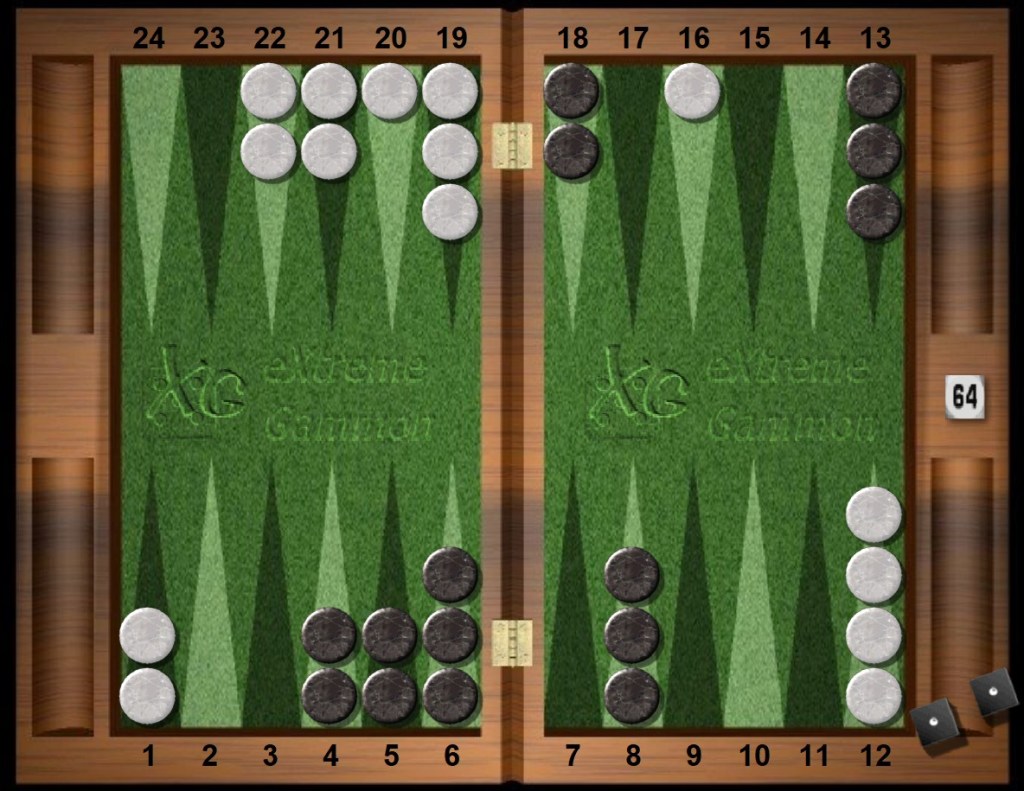
The cube situation is a reference take proposition, well past the front of the doubling window and now tiptoeing 3mp beyond the backdoor Pass.
What is the transition of market losers?
When Black first glances at the cube, Black only has eight market losers: Black’s upcoming 66s followed by eight White plays that develop nothing. Given that an exchange of a Black roll then a White roll creates 1296 situations (several are duplicates), eight such situations are negligible.
The second time Black glances at the cube, after his play of the first boxcars followed by White’s home slot, Black has 664 market losers. This tally is more than half of the upcoming exchanges and for a first double (with the Jacoby rule) is always a cash — White must pass.
Upon the third glance at the cube, Black doubles and White passes. In this situation Black has 796 market losers, almost two-thirds of all exchanges. Of course White passes.
Some backgammon players might wonder whether all this actually matters. Before the second 66s, Black could have doubled and White could have rightly chosen to pass. After the second 66s, Black doubles and White does pass. Same loss of the initial stake. So what is the big deal?
The position shown above is a reference take point. A cube after Black’s first 66s can be correctly dropped by White or correctly taken by White. White does not like the idea, but White loses the same amount on average by passing or taking. Not so of Black, however. After the first 66s Black has 664 market losers and after the second 66s Black has 796 market losers, which means White will pay the original stake to pass 132 (796-664) exchanges after the second 66s but would pay twice the stake for finishing these 132 game exchanges when taking after the first 66s — and Black will clearly win most of these games at twice the stake. The blunder of Black doubling late cost Black an extra 1/8 of a point of lost profits, according to rollouts.
<————> ND <————> D/T <————> D/P <————>
RTP. Reference Take Point. This cube decision seems to be either particle-antiparticle, a balance on a knife edge, an enduring battle between cataclysmic forces at twice the stakes, or an eerie silence with peace and quiet bought by the Drop.
Take or Pass? Only Lady Luck can say.
 the baron talks backgammon