Here is a recent game. The early opening creates a parallel game plan where both Black and White are waiting in a mutual holding pattern. Even quiet games require careful checker plays, especially to squeeze out some small advantages.
Black makes a mistake early on. Sometimes, in a close game, it is worth injecting a mistake into a game position with the Play-From-Here feature of the bot and do a few hand rollouts, either to correct a mistake over the board or to introduce a weaker variation for contrast.

Black begins with the opening toss of 62s. Other posts suggest that opening 62s are candidates for the club of “natural” openings. Membership as a natural is predicated on all other choices as mistakes. Here the only play is the big split and the outfield spare down.
White replies with the toss of 34s. As an opening roll, three-fours offer four acceptable choices: both checkers down into the outfield, one checker down and one split to the golden anchor location, a checker down and a checker split to the high W21pt anchor, or both runners splitting ahead to start both high anchors. After an opening 62s toss by Black, however, only the play of White 24/21 13/9 is best.

White 34s reply shows constraint and an eye for small differences. If White splits to the 20pt then her blot will be attacked by three direct shots. Hence splitting to the 21pt is safer. In addition, 24/21 13/9 duplicates Black’s favorable deuces.

A combo six makes the barpoint anchor, which was Black’s plan all along.

The game flow is simple and exhibits a symmetry of progression. Both Black and White have barpoint anchors, both players are bereft of home board points, and both have an outfield blot coaxing the other to break anchor to hit. A simple symmetry count says White leads the race by two pips but Black is on the roll. The situation has an austere beauty, almost a new starting position, but with first strike advantage for Black who enjoys the roll and the initiative.
Now the plans are clearly a mutual holding game, neither currently ahead in the run but awaiting a chance to flee safely after high doubles on the dice.
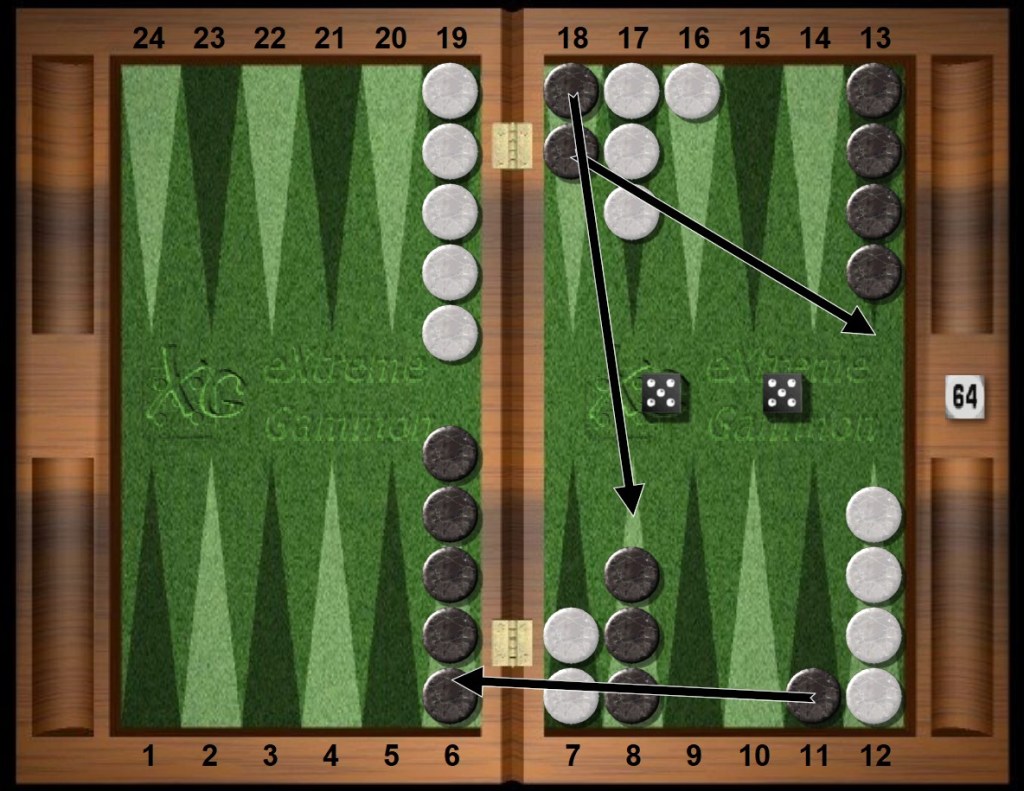
Black rolls double 55s, a splendid improvement. Whoever clears the anchor to safety suddenly leads in the game. Black’s equity jumps from +0.07 before 55s to +0.47 after, according to the bot during the aftergame study.

White rolls 24s. Normally, making the White home 4pt with White 8/4 6/4 is obviously best but now, because of the strategic situation, making the home point is tied with making more points faster in the near future. Hence White puts more checkers in the Zone and also slots a home point. The two plays are equal in equity, primarily because Black has outfield spares that make forced blots unlikely soon and White wants to hit later in the game anyway when it is a knockout punch. Hence White tries to build a superb board quickly. The next few plays continue with White’s mindset.

Black rolls the excellent double 22s and makes a mistake. In backgammon the roll of doubles on the dice (here 22s) means that Black must take extra time to squeeze every drop of equity from the situation. To do so, always find the three best candidates and then rank them. Make certain that each lovely roll of doubles is compared for the three top plays.
Here, due to recent symmetry in game plans, White’s objectives still apply to Black. Therefore, Black must make a new outfield landing post (either 11pt or 9pt) and downplay the early need for home board strength. White will not be volunteering blots any time soon, and neither will Black. Hence the three choices (in equity order) are the 9pt, the 11pt with spare, or the bronze medal 11pt-4pt combination. In the game Black chose the combination. The 9pt is correct.
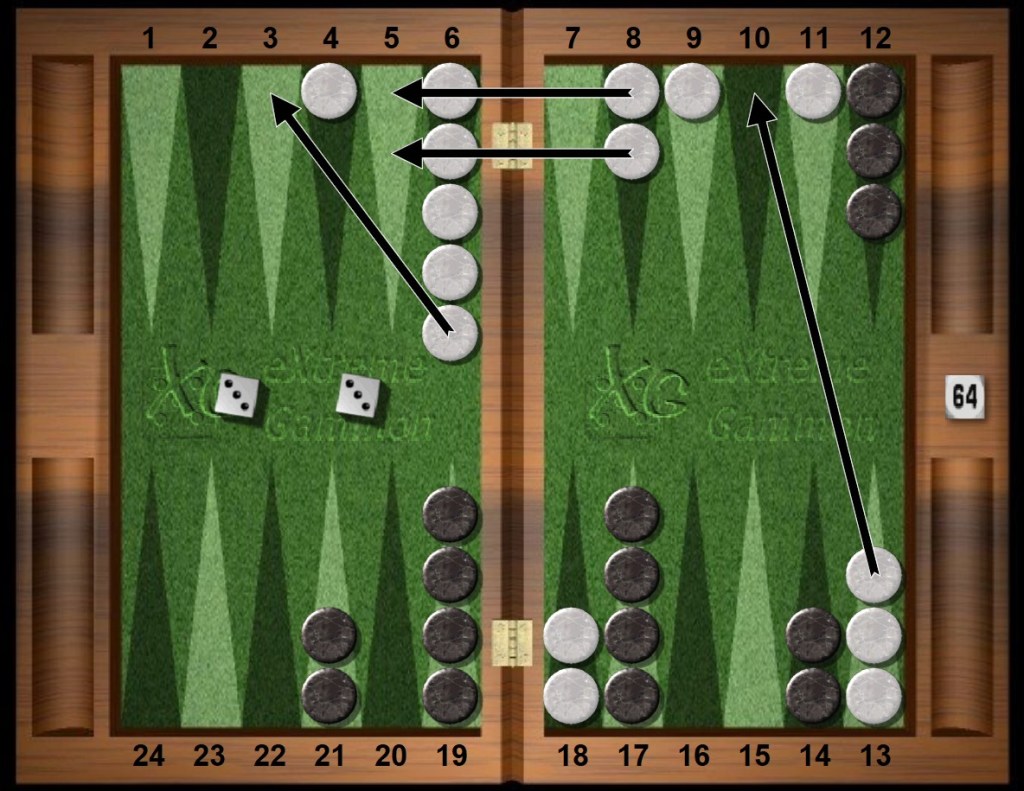
White also rolls doubles, this time 33s. White places maximum checkers in the Zone, makes the golden point, and slots the home point development. Fully consistent with the details of the game plan.

With B62s the midpoint spare slots the black golden point.

With W56s White covers and adds a spare onto the W4pt as an ace to cover the 3pt blot.

Black puts an outfield spare into the home board, slotting. Both White and Black are building to a climax.
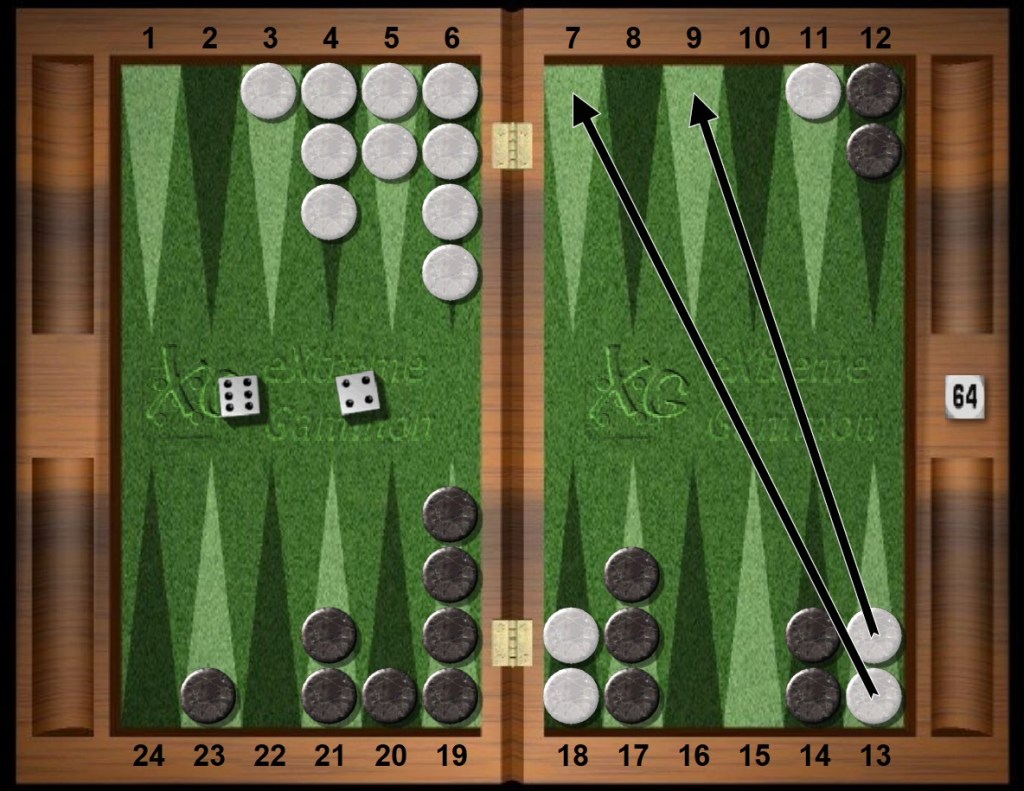
White clears her midpoint in an effort to make a full prime soon.

Black rolls the perfecto 52s to clear his midpoint, ironically making his previous mistake the “right” play. That’s backgammon!
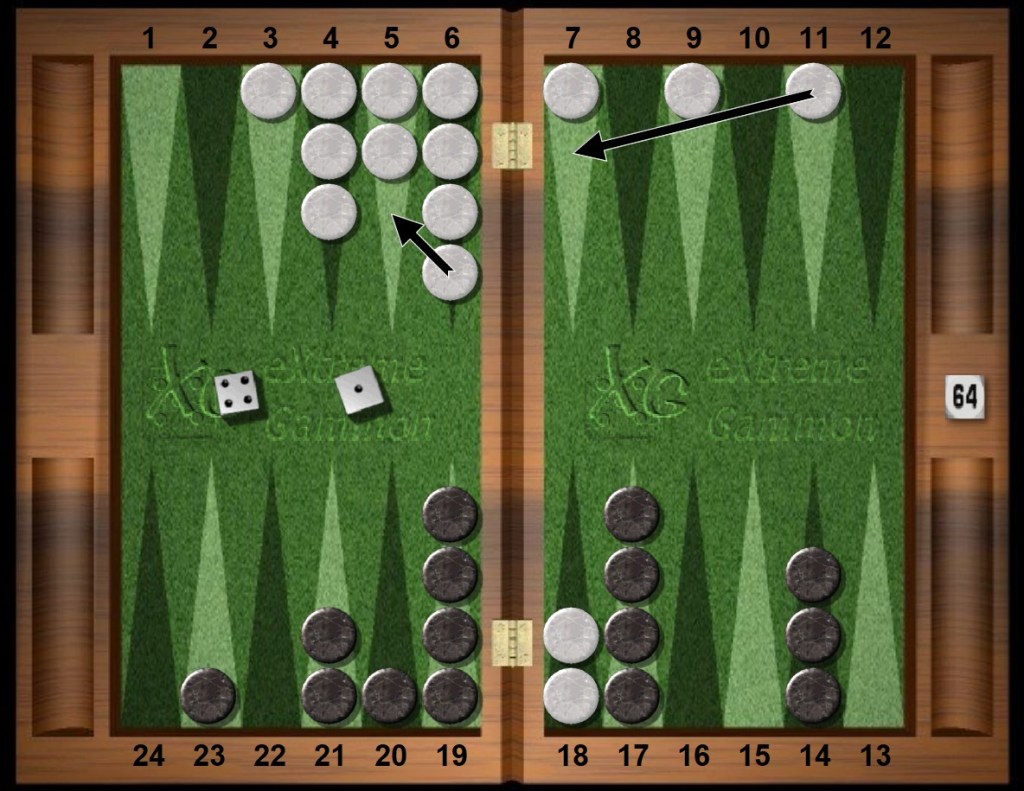
All thirteen White checkers are connected directly to the climactic prime.
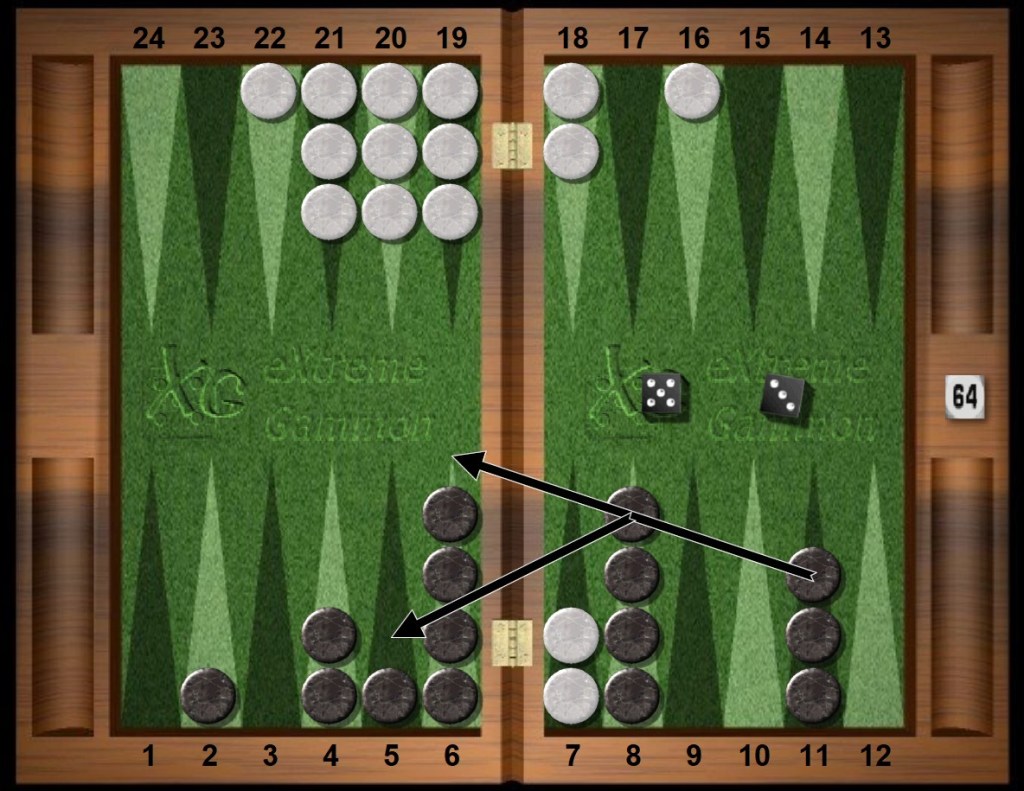
There are four acceptable plays. This choice blots on future Black 66s.

The home board is ready for action.
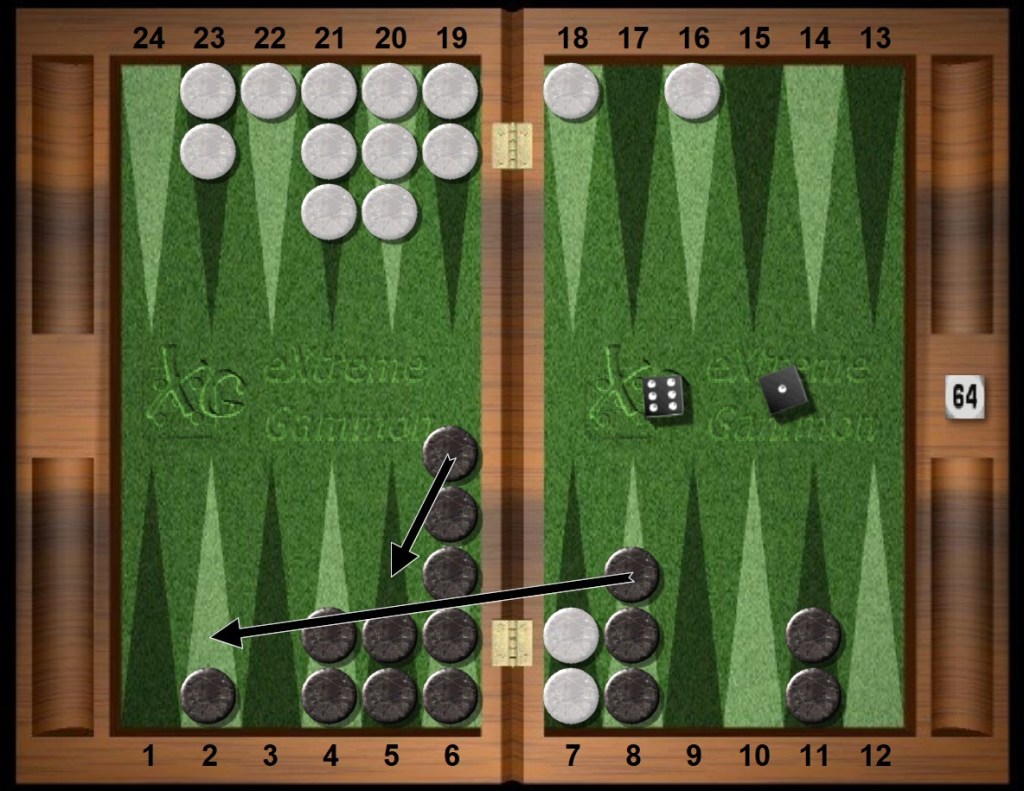
Black brings the spare home, making boxcars (66s) a happy roll but now worrying about B61s.
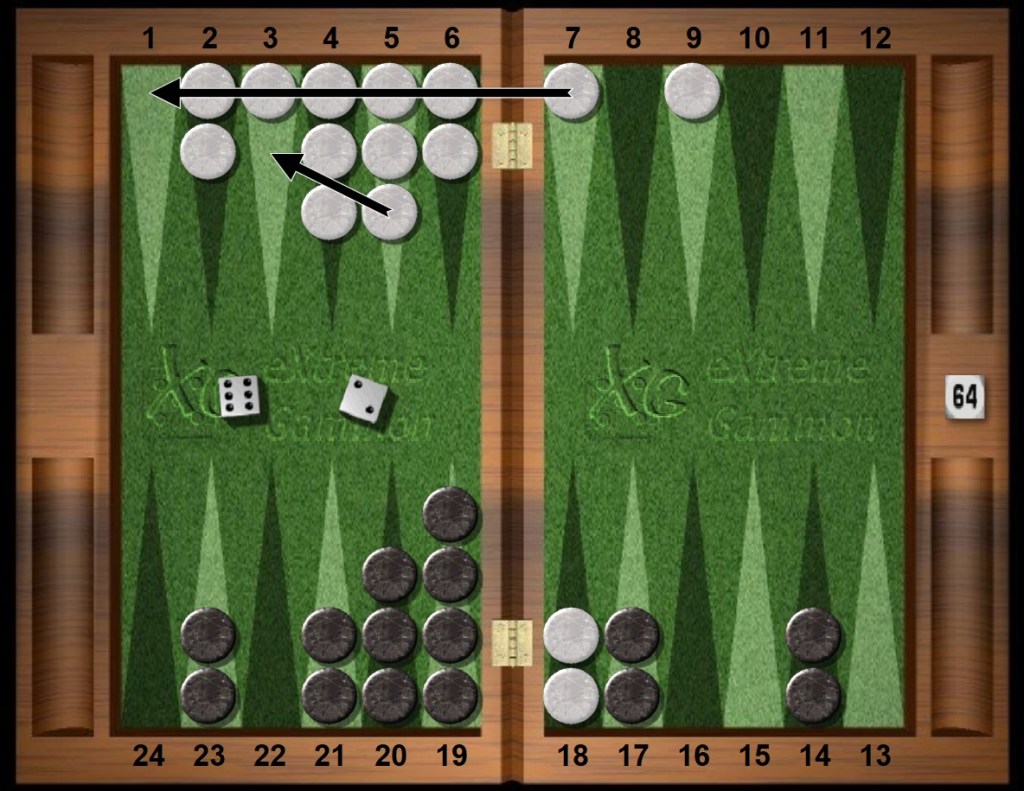
The climax of this game has arrived ….
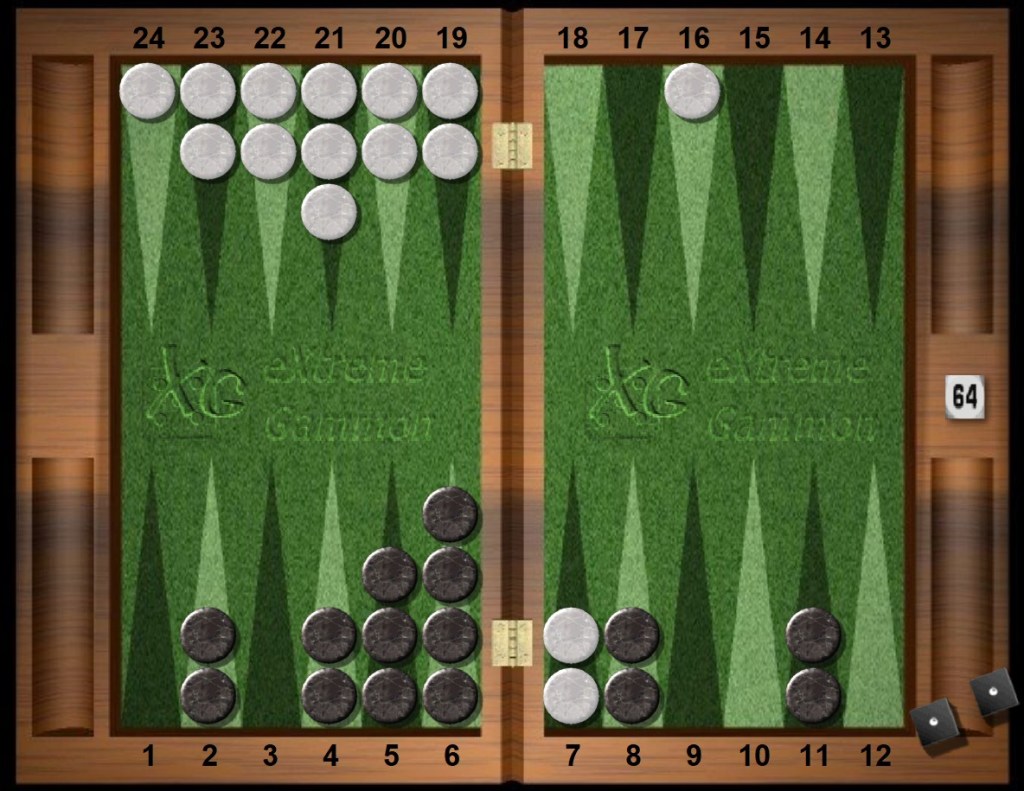
Black is set to win almost 2-out-of-3 games from here. Nearly, but not quite enough to cube.

A waiting play ….
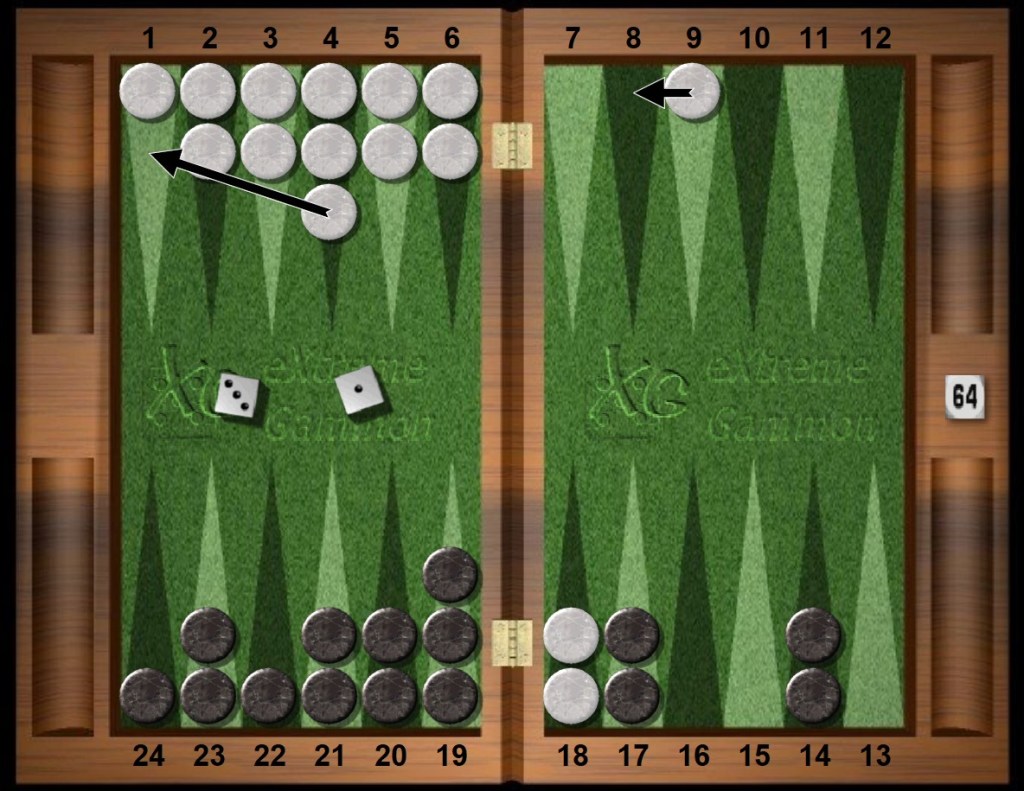
White makes a closed board with seven pips timing on her side and a dangerous anchor on Black’s side. White’s closed home board should last awhile.

A question of cube action? A lovely benchmark position. Does Black have enough to double? Can White even take?
In a footrace Black still has only a half roll lead, on average. Neither White nor Black is likely to lose a gammon. Black has few threats to attack just yet. Black has structure, but so does White. And Black has the initiative — it is Black to roll and only B61s instantly leaves a black blot. White breaks her home board or blots on only eleven rolls {26s, 35s, 36s, 45s, 46s, 44s} but is not necessarily hit.
Therefore, the market losers boil down to big dice for Black, clearing at least the 11pt followed by an anemic response by White. Aftergame study computes about 177 market losers (in 1296 exchanges) or less than 15%. And the volatility is not particularly high, about the same as the start of a new game. Thus, not enough to turn the cube.
Hence Black does not cube.

If White does not roll high doubles immediately, Black will cash the game (since a market losing exchange has remained undoubled).
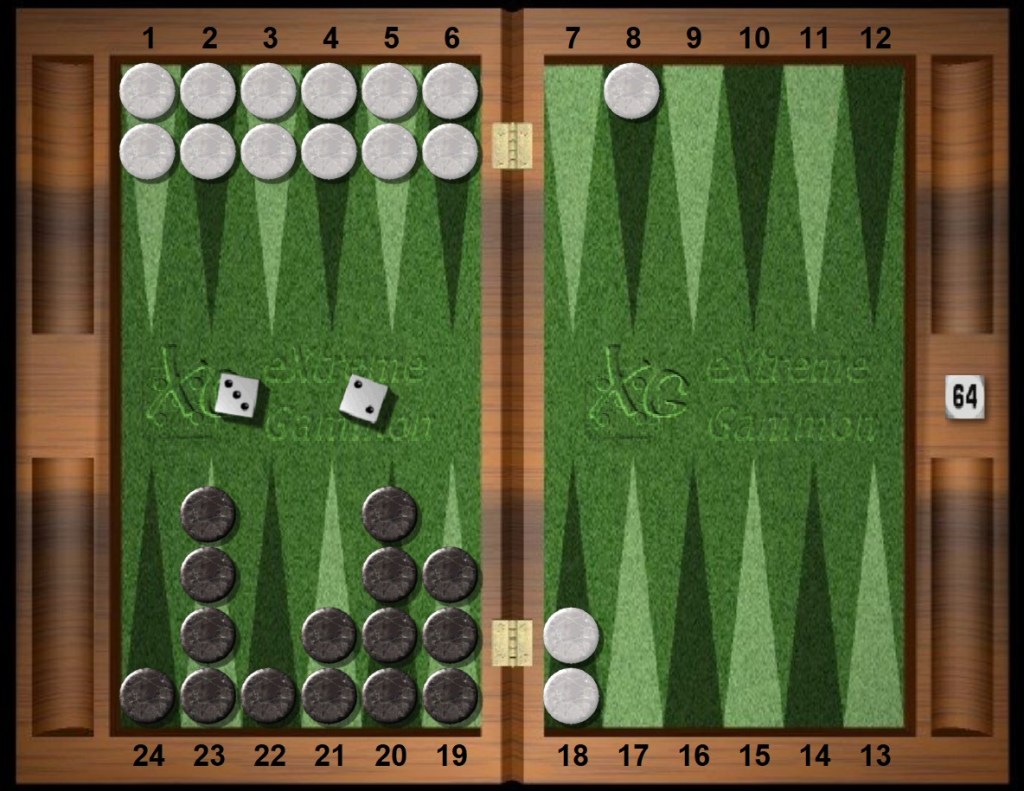
The exchange B66s-W23s is a market losing sequence. That does not mean Black has made a mistake by waiting. Black needs enough market losers to cube before the last roll. But it does mean Black must now cash the game.
Black cubes and White drops.
To recap: Black correctly waited to double, then rolled boxcars, and White wimped her roll in reply, thus creating the correct cash of the game for Black. Voila.
 the baron talks backgammon