Details matter in backgammon. Sometimes a learning technique is best applied to small differences. The bots make posing and answering these What If? questions very easy, perhaps too easy. Backgammon positions quickly modify and morph, leaving a trail of equities to interpret. Yet insight can come from introducing small controlled changes, clearly attributed.
Consider this position. Cash game with Jacoby rule. White doubles. Should Black take or pass?
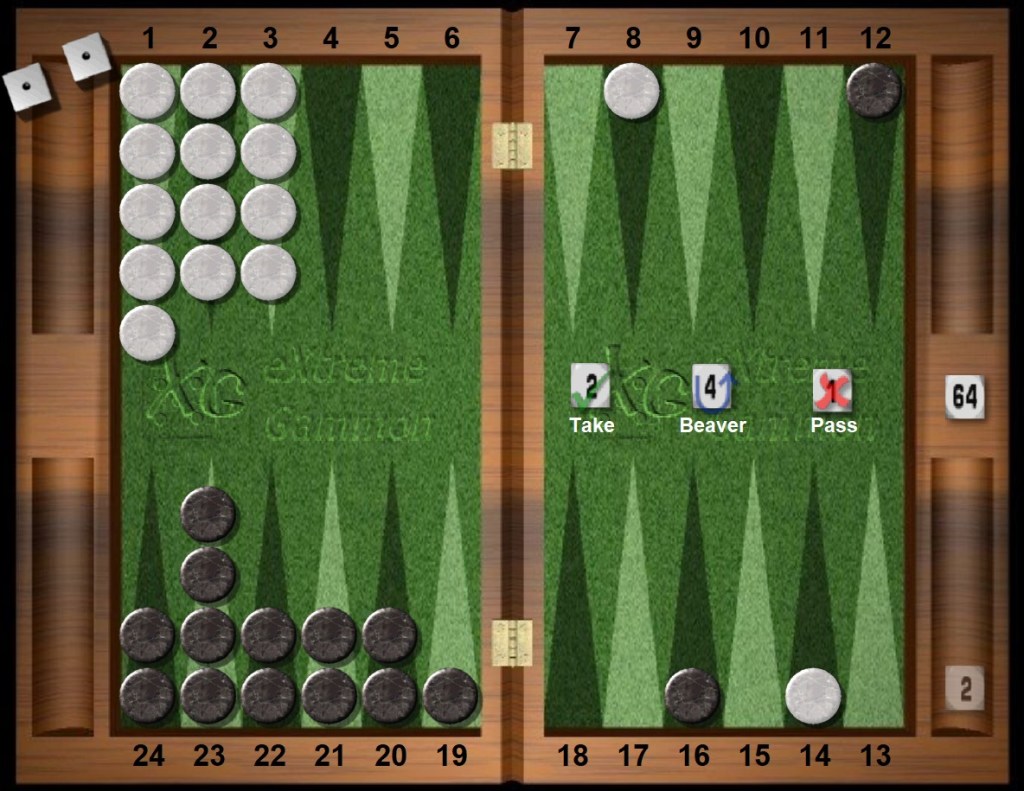
White’s home board has crunched. Black’s home board is poised between crunched or closed. White has a racing lead of 15 pips, almost two rolls before White tosses her dice. A white outfield blot stares down a black outfield blot. With White on the roll, a dozen shots hit the black blot. Black would have some return shots from the bar, and a scary home board to energize any return hit.
After extensive rollouts, this position is a very close D/T by 18mp, not quite within the razor-thin definition of a reference take point, but close. Almost a reference take. Perhaps morphing could “reference” it. In short, an unhappy Black should take this cube.
Suppose Black takes after White doubles and then White rolls 12s. Should White hit the black blot? Although converting into a straight race seems safe and wise, it is a huge blunder NOT to hit the black blot. Two rolls are not that far ahead for White in a straight race. Factoring in the 1-in-4 chance of Black dancing, the hit gives White a four-roll lead (assuming no return hit).
If White rolls 24s or 25s or 26s, White should also hit but an outfield checker buttons up or lands home.
If White rolls 23s (instead of 12s) then White can either hit or not hit. Extensive rollouts calculate the same equity (to within 7mp) — a photo-finish.
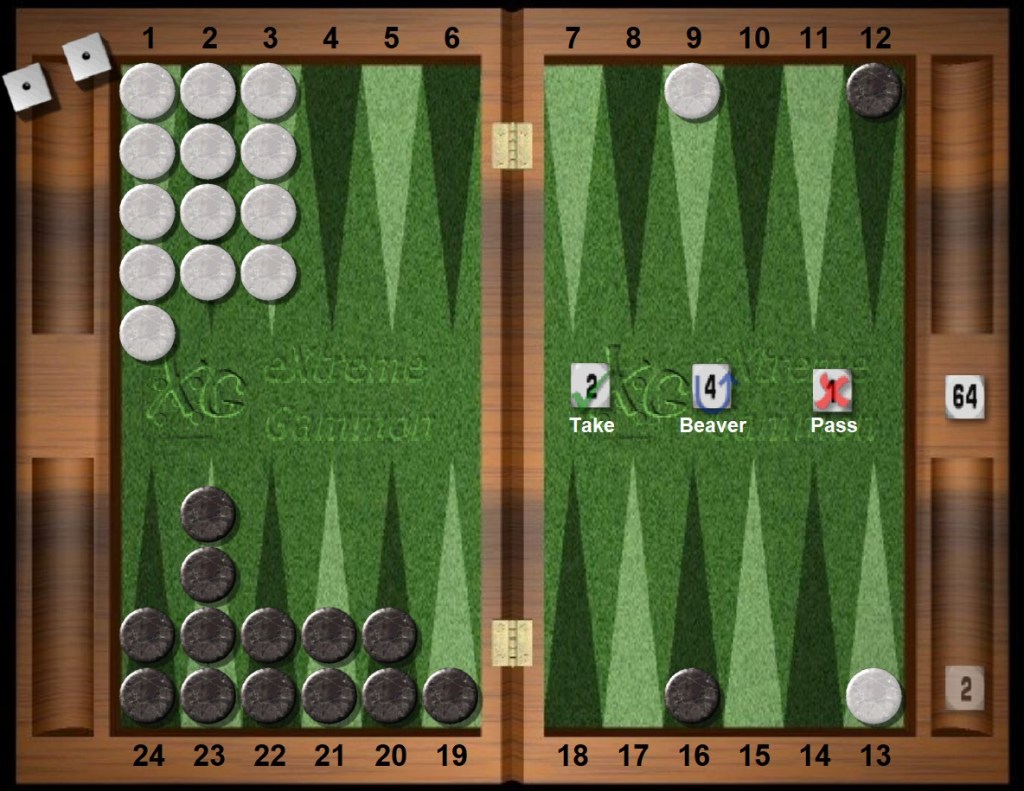
This position is to be contrasted with diagram 1 where the pip count is identical and the home boards are identical, but the white blots are closer together at 13pt_9pt than the 14pt_8pt previously. Again, after extensive rollouts this new position is now D/P by an equally small margin of 14mp. A reference position would be somewhere between these two outfield positions, if that were possible, although hidden from observation.
In the original situation White can hit with a dozen shots and skip by after the other two dozen rolls. In the 13pt_9p position only eleven rolls hit, yet White’s position is slightly more powerful.

Perhaps a third running position? Again, same home boards, same pip counts. Now a pure racing game. One fewer crossover each. Extensive rollouts place this racing position as D/T, an easy take at 76mp below the take point, due to the absence of both initial hits and return hits.
White needs the extra contact even though Black has the stronger home board. White has the initiative to hit a black blot sometimes, thereby improving her racing lead. When White does not hit, White can then turn the situation into a safe running game. By contrast, Black only has combo hits from the bar, or no hits at all. Without the initiative, Black never gets the chance to hit with a direct shot in the outfield.
 the baron talks backgammon