A recent game. Cash game Jacoby rule. White opens with 15s, makes the minor split and brings down a midpoint spare to stack the white outfield point.
Black replies with the “natural” roll of 62s.

The classic opening play of 62s is used as a reply here to White’s minor split. It is no longer the best play. Now the pedestrian run of 24/16 is slightly better.
The idea of shelf life for opening plays is worth exploring. Under what situations is a natural opening play counterfeited by the opponent’s earlier rolls? Here, the big split to the barpoint and the safe blot down from the midpoint is instantly discarded in favor of a running play into one direct shot.
White now rolls 13s and makes her 5pt — standard building play.

Black rolls double 33s. As a lesson on assets, Black must make two very good assets — the barpoint anchor and either the home 3pt or the outfield 10pt. Single asset plays are wrong here.
Now White rolls 26s. White puts a spare onto her 5pt — quiet but effective since the running game is still possible for both White and Black.

Black rolls 52s and structures the outfield safely, preserving a possible running plan while threatening White’s split runners from afar.

White rolls double 66s. A forced play but now White leads the race. And a perfect time for both White and Black to pause briefly and do a strategic evaluation.
Essentially, apply Sly’s RST rule to discuss game plans. White is somewhat better in races, White has better home board structure although Black has a good anchor and the makings of a blockade, and both White and Black may have some threats to attack. Nowhere near a first cube.
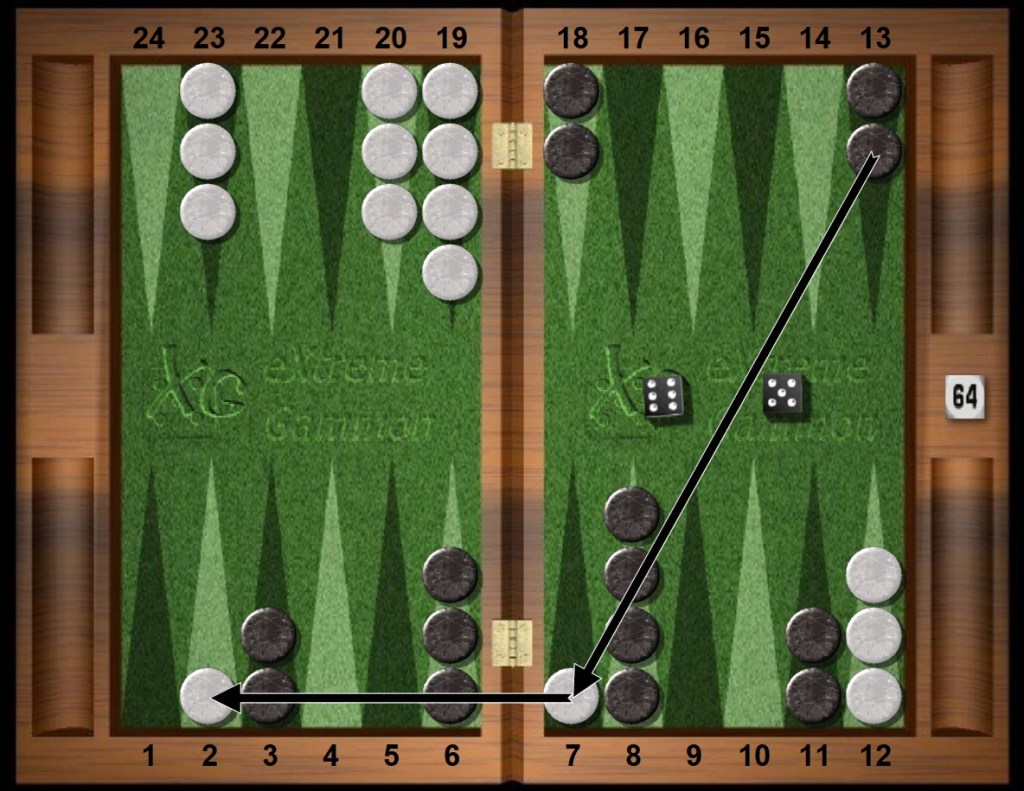
Black rolls 65s. Black must hit the white blot on Black’s barpoint. Should White make the barpoint anchor, White will gain a stable parallel structure with a racing lead. Black therefore must hit the 7pt blot immediately.
It turns out that the twin hit of 13/7*/2* and the single hit of 13/7* 13/8 are both acceptable. However, fighting spirit demands the twin hit (take that, you bot).

Another forced play, as White enters both checkers from the bar and hits Black’s loose blot. Again, after a forced play with strategic issues, a brief evaluation of game plans is worthwhile. Now Black is dancing on the bar with another outfield blot, so threats favor White. White’s running lead is even greater. Structure now slightly favors White.
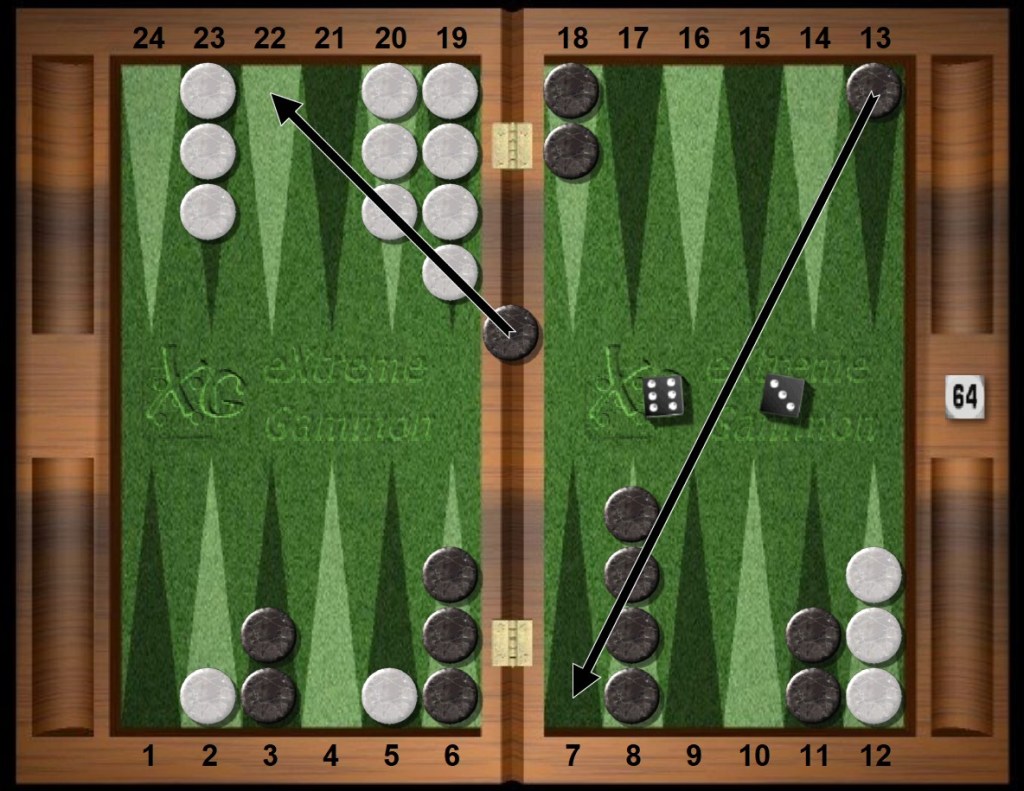
Black enters with the three and has four choices for the play of the six. Ranking these choices is a worthwhile exercise. Running into the outfield with Bar/16 is the worst play even though it connects the two black blots geographically. The loose hits inside the Black home board are both risky because they leave too many black blots scattered about. The best play, perhaps surprisingly, is to slot the vital black barpoint, leaving a double direct shot but minimizing stray blots. When missed, the 7pt in a blockade becomes valuable. When hit, sometimes Black can anchor inside White’s home board.
Black enters the checker from the bar and slots the black barpoint.
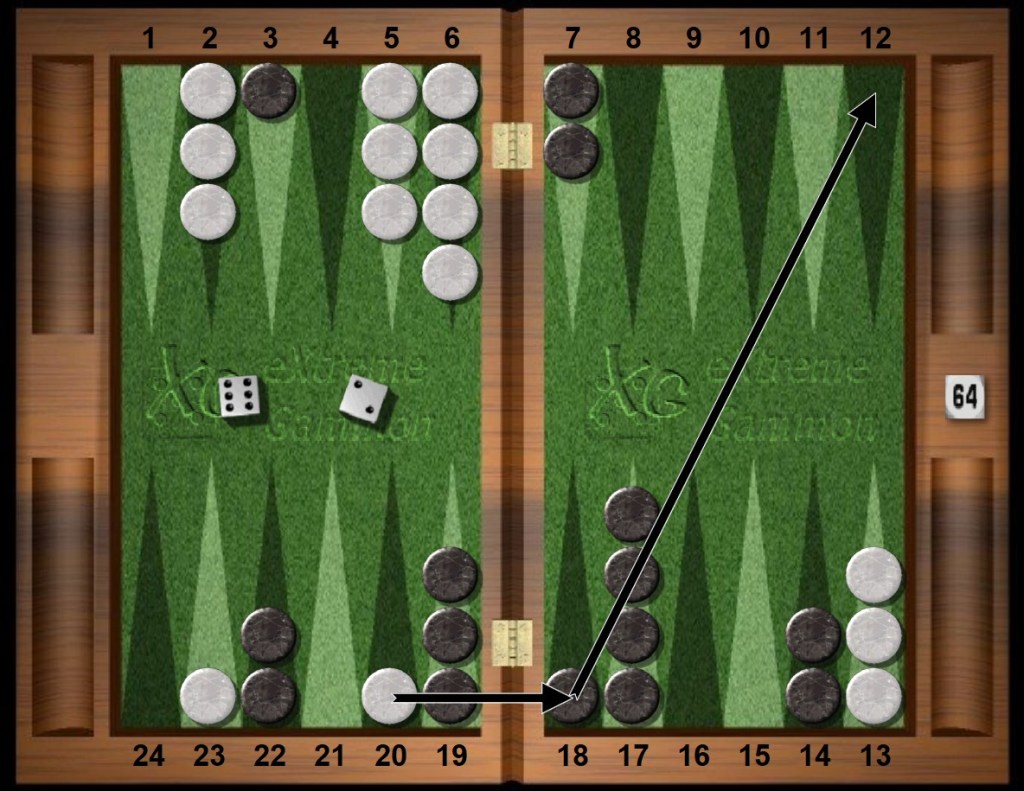
Now White rolls 26s again, which hits the black blot en route to the white outfield and into a possible running game. Before the roll White has positive equity (wins a bare majority of games) but White is not ready to double the stakes.
Before White’s roll (of 26s): What would be needed in the upcoming exchange for White to cash the game soon? Answer: White would need to hit (which soon occurs) and Black would need to dance.

Black dances on the bar.
The White hit en route and the Black dance together are a market loser, but before White’s last roll (26s) White did not have enough prospective market losers to cube. Now, after the exchange, White must double as an unanticipated market loser occurred. If White could see the future, White would prefer to cube before the W26s hit and B65s dance exchange as White would then be paid to finish the game at a higher stake.
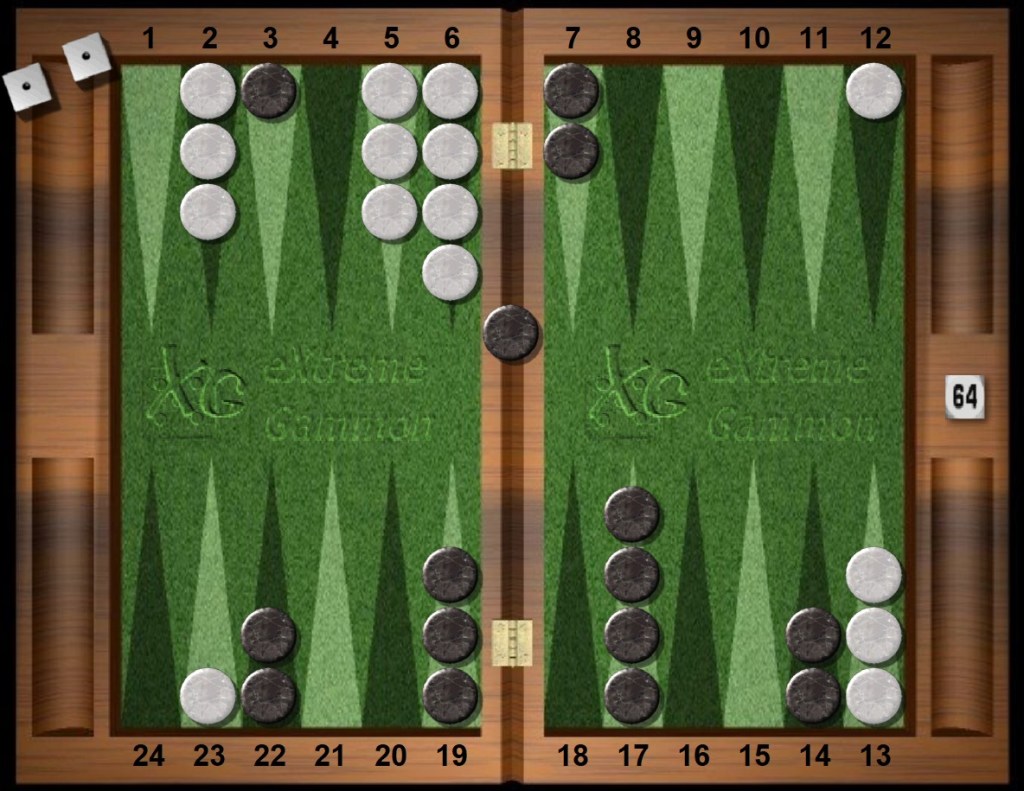
Black dances on the bar.
Sly’s rule fits this situation rather well.
Threats? Black is dancing. Another black blot is vulnerable in White’s home board. And White has home spares to focus on home points and on Black’s blots entering. Checkmark for Threats.
Race? White has a huge racing lead and an easy exit plan for her single runner. Checkmark for Race.
Structure? White’s structure is at least as good as Black’s plus White has the initiative to improve structurally, if possible. Smaller checkmark for Structure.
Gammons ? Specifically, there is a big likelihood for White to win a gammon. For Black winning a gammon? — Not so good.
Although Sly’s rule is used primarily to determine first cubes, here it also informs about the Pass of a first cube.
Extensive rollouts (20736 cases) confirm this cube action as Double/Take, but Double/Pass is perfectly acceptable (only a 15mp error to Drop)
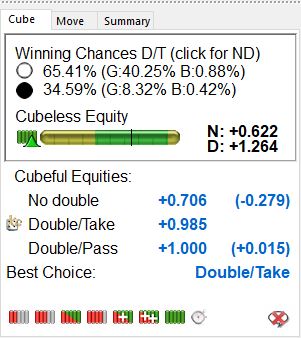
This position is accepted as a reference takepoint, saved as RTP_0982. The cube is OK to take and OK to pass, although by no means enjoyable.
Of White’s 65% winning chances in completed games, fully 40% are gammon wins and thus 25% are single wins. Black can only muster 8% gammon wins and about 27% single wins.
White Doubles and Black Drops.
 the baron talks backgammon