This game gets away from Black’s control early in the fracas. Perhaps the experience can be adorned by a quick lesson is counting.
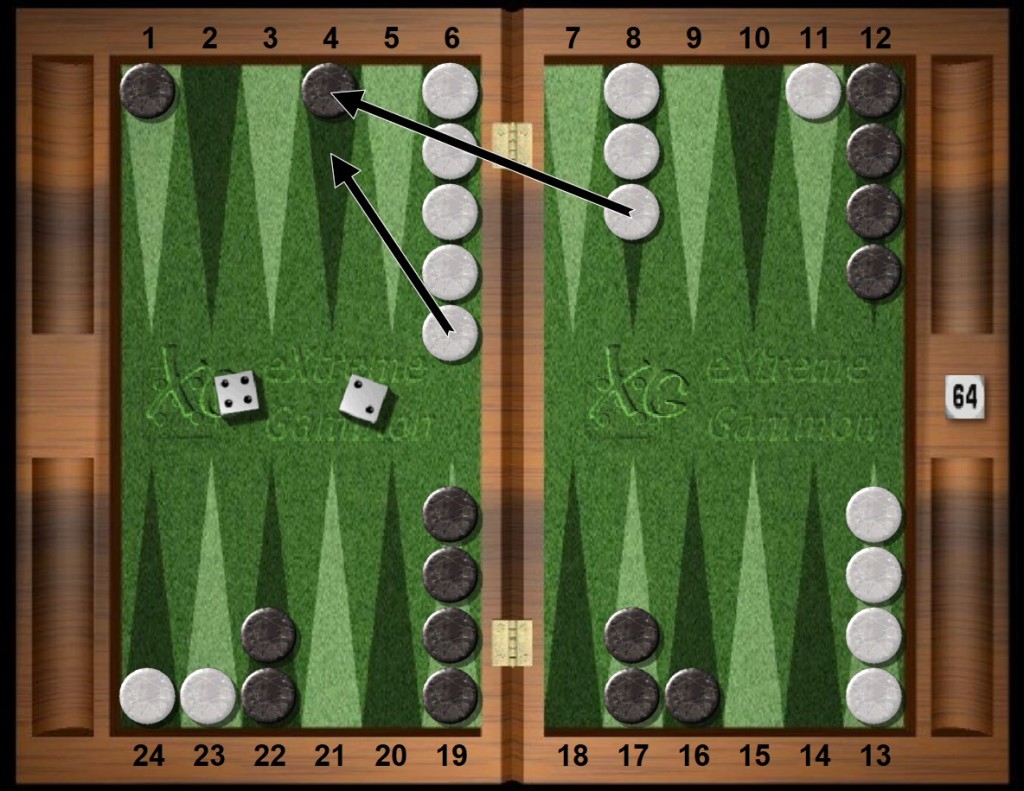
Black opens with 53s and makes his home board 3pt.
White replies with 12s and makes the minor split, bringing down the safest builder from her midpoint.
Black rolls 43s and plays the classic minor split and the best builder from his midpoint. Black leaves three blots scattered about, as does White.
White rolls 24s. Wham … a perfect roll. White points in her home board, hitting the black runner.
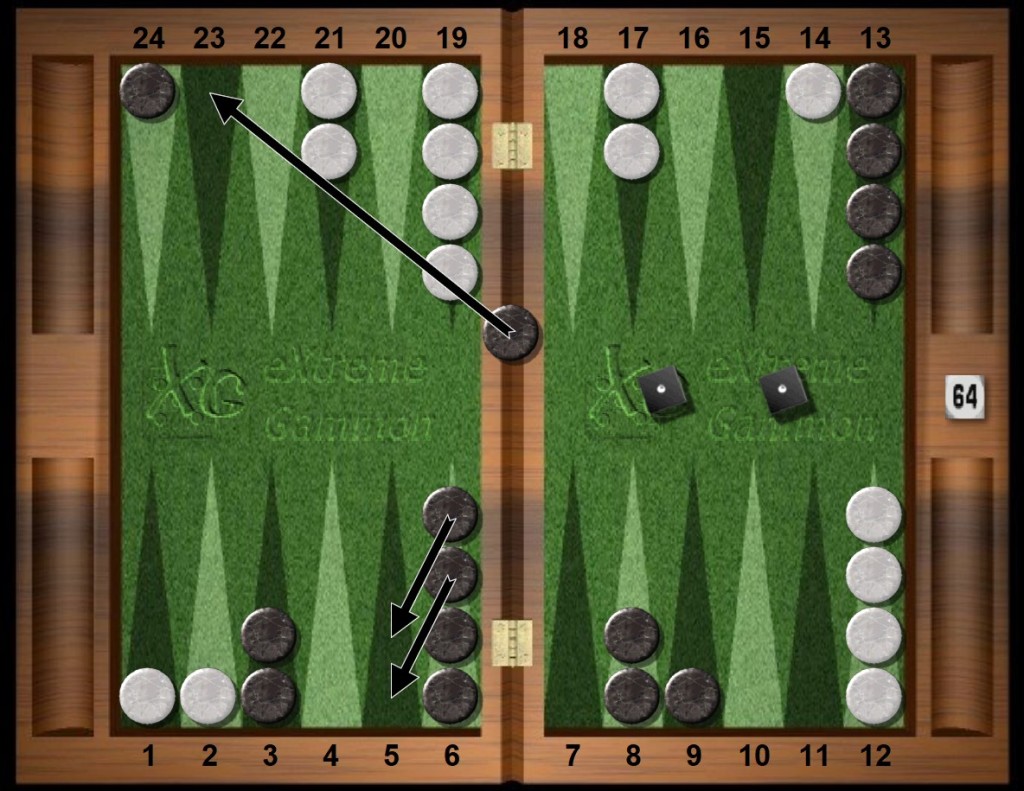
Black rolls double 11s. Black enters from the bar, makes his golden 5pt, and splits his runners. Now both Black and White have split runners and both have made an excellent home point. Some symmetry, some parallel development.
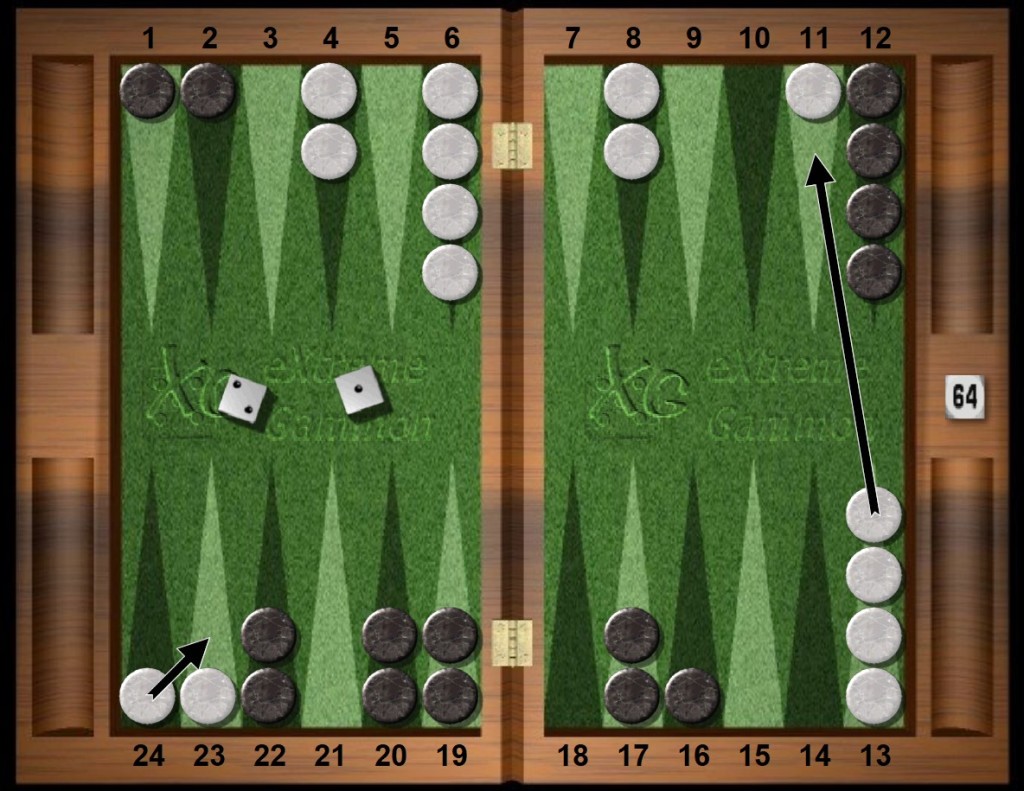
White rolls 12s again. White buttons up. No need for stray white blots.
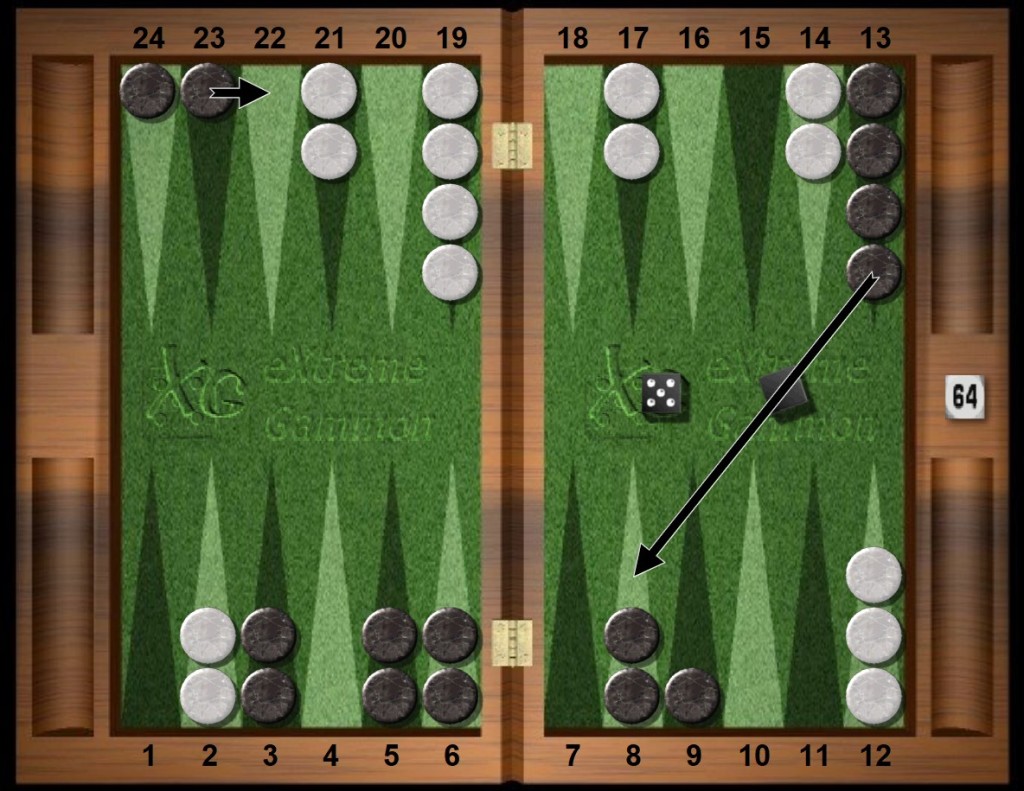
Black rolls 51s. Black needs to make an anchor better than White’s deep anchor. Even though it is risky, Black must stay split.
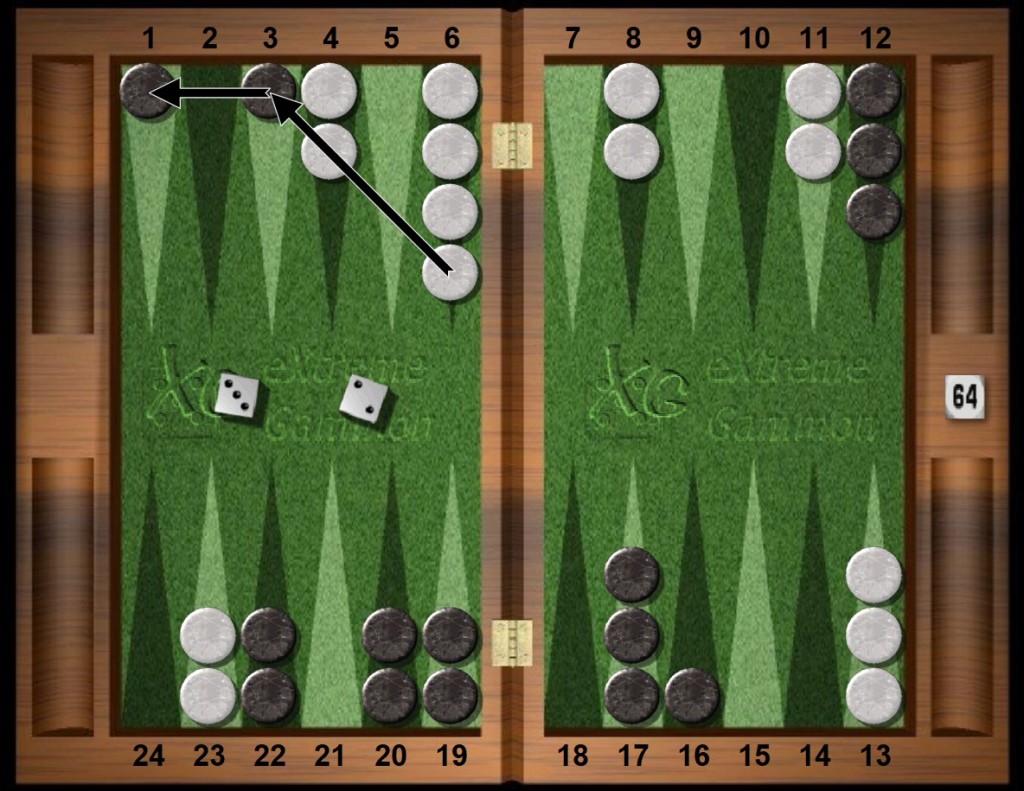
White rolls 23s.
Wham again. The twin hit loose. Now White’s current game plan is Attack.
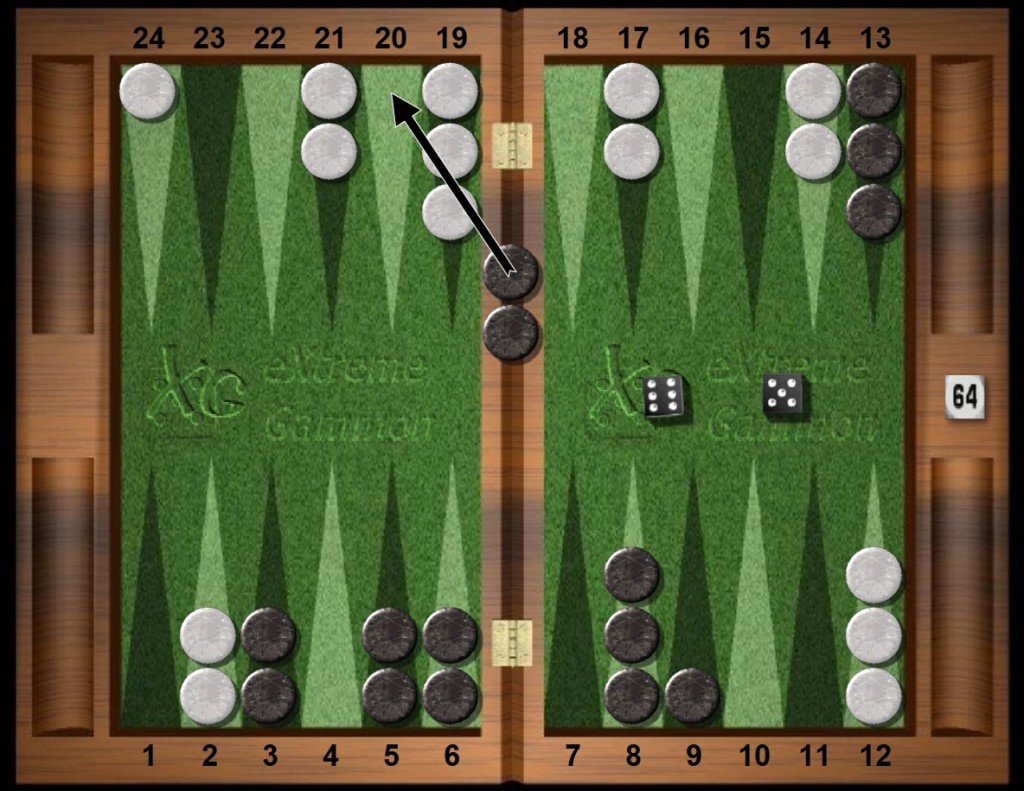
One checker enters and one checker dances on the bar. This dice roll foreshadows the inner defeat and the booby prize of shot counting.

White pauses briefly to consider a Double. White certainly has threats. But Black has the better home board and a slight racing lead. White has a home blot. Doubling on the threat is just not good enough. The cube decision is a Beaver — no way should White cube here.
Then White rolls a magnificent double 44s, hitting on the way to covering the acepoint, and putting two black checkers on the bar.
Gone from a beaver to a blaster in just one lucky roll.
From later bot analysis, the two black checkers on the bar flood the top dozen choices before a contrary move that has only one black dancer is added to the list. Think about that. White 13/5*/1 is a must make play, with many blunders already on the list having two up until a single dancer play appears. Imagine how big a blunder it must be for that single dancer to seem right!
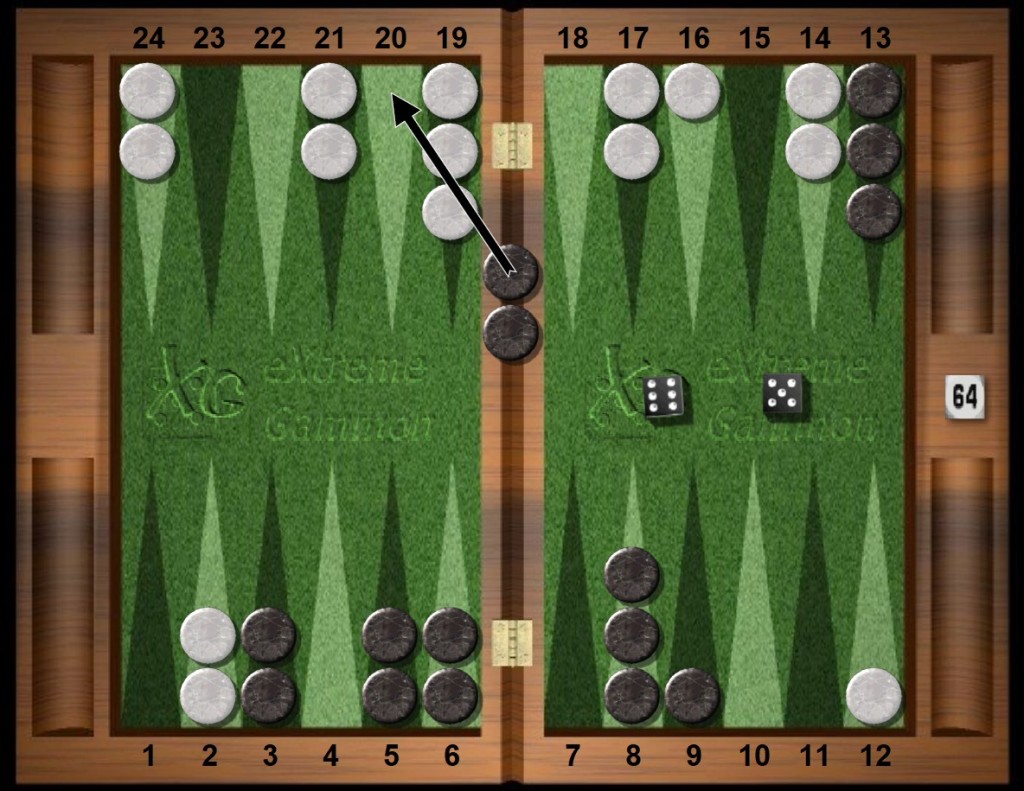
Black rolls another 65s. One black dancer enters from the bar. How often does that happen?
As an outcome for Black’s entry, it seems about average.
A good opportunity to practice some shot counting. When Black has two dancers on the bar confronting White’s n-point-board, the shot counts to enter become “perfect squares”, namely n-squared. Usually, there is a trio of mutually exclusive categories: Black enters neither checker, Black enters both checkers, or Black enters only the one checker.
Here, two black checkers dance by the number of white home points made (3 – the 1pt, 4pt, 6pt) then square that number. Hence White has three home points made and three squared is 9. So 9 of Black’s rolls dance completely.
Also, to enter both dancers, again square White’s gaps (3 – the 2pt, 3pt, 5pt) to enter and anchor Black. Similar to both dancing, the entry of both black dancers has the same logic, the gaps squared is again 9.
That is why Black 65s is an average roll — only one black checker enters with exactly 18 rolls (36-9-9), or half the time.
A simple yet clear position on entering twin dancers from the bar, along with a handy counting trick.
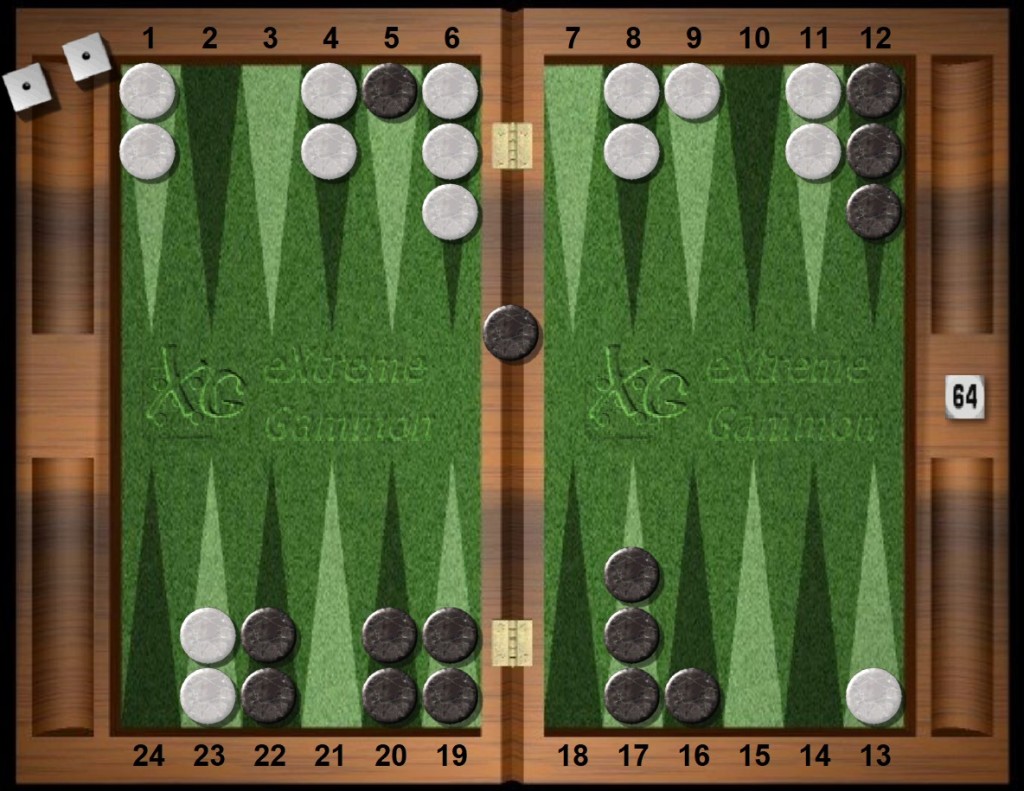
White to play.
An obvious Double and a nervous Take. The overall winning chances for White are about 2-to-1, a common lower bound for cubing. The structures of both White and Black are complex, and Black can still win his fair share of gammons. However, White can blitz and thus Black may lose many more gammons. In fact, a majority of White’s wins are gammon victories. Thus a easy cube for White.
In a nutshell:
White’s 2-to-1 fraction of wins is an early borderline;
Black still has the typical opening share of gammon wins;
but White’s gammon wins are triple the opening fraction.
In fact, White wins more gammons than single wins.
A good recipe for an early Double.
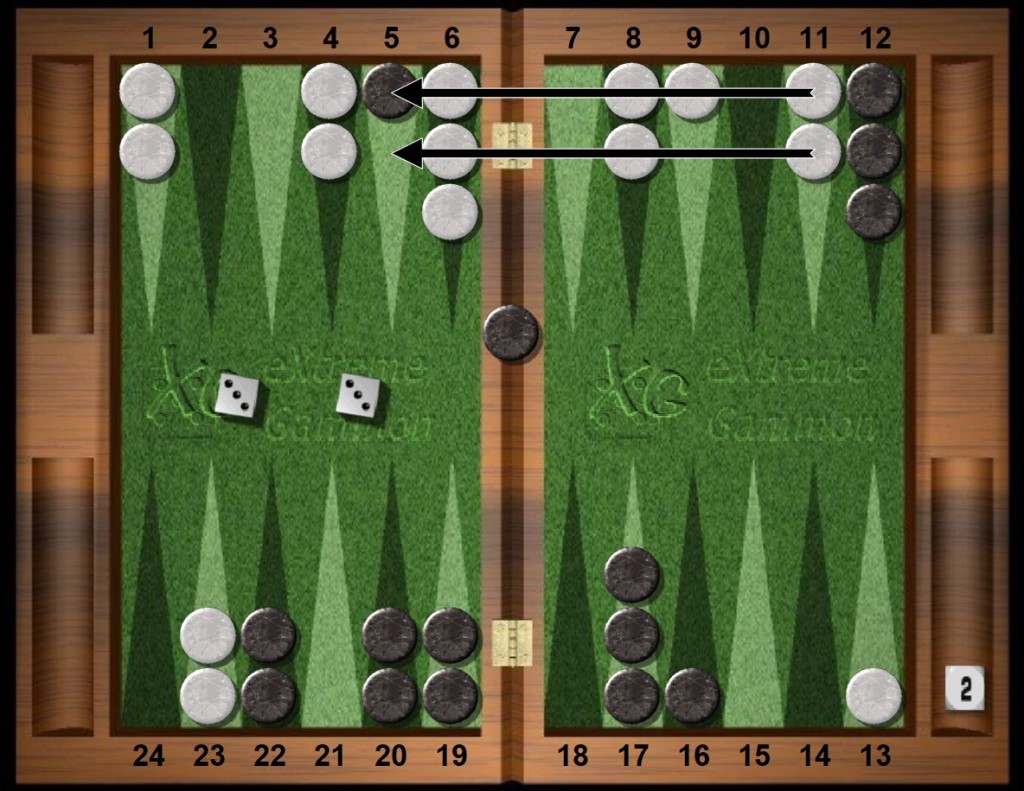
After an opening Double and Take, the checker play of the followup roll is usually among the most complicated and treacherous plays in backgammon. If the situation was not complex, the Double would not be a double, as volatility and market losers always enter the decision to cube.
With the next roll, White’s double 33s crush Black in a vicious attack. Here, the care in checker play maximizes the number of builders directly aimed at a closeout. The correct play for White leaves four builders directly targeting the two home gaps.

With another 53s Black enters one checker from the bar.
Same counting question.
To enter both dancers is two gaps squared, equals 4 shots.
To enter none is four home points squared, or 16 shots.
For one dancer entering and one dancer detained, that leaves 16 shots (36 – 4 – 16). A straight count to verify: 63, 62, 53, 52, 43, 42, 13, 12 totals 16 shots.
Two checkers on the bar leads to perfect squares in the shot counts.
Practice makes perfect.
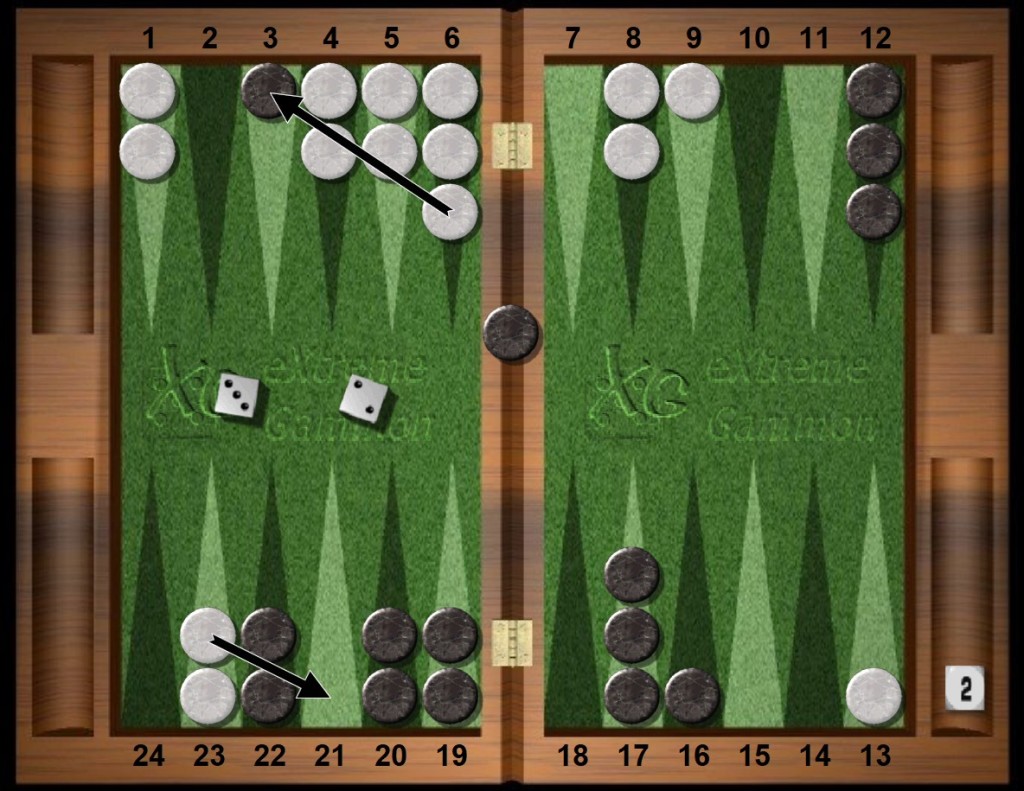
Conventional wisdom suggests: “Don’t Split When Hitting Loose.” but here the contrary advice is correct, required in fact to complete the closeout.
If the map and the terrain disagree, trust the terrain.
Swiss army aphorism
White plays 23/21 6/3* and goes full boar for the knockout punch.

Black dances …
From here on in the game:
Black is closed out,
the bear-in and bear-off for White goes smoothly,
Black’s delayed entry from the bar disconnects the armies,
no chances whatsoever for Black,
and Black loses a gammon.
No amount of genius can overcome obsession with detail.
traditional
At least Black plays perfect backgammon for the next (let us count them) sixteen rolls …
 the baron talks backgammon