In backgammon there is the opening roll, and then there is the opening reply.
The fifteen opening rolls allow for twenty-eight “acceptable” initial plays, where acceptable means to within 2 cents on $1 of the best equity choice. Plenty of scope is available for your style or your opponent’s confusion. Having the opening roll is always good, a positive equity, with the best opening 13s (makes the 5pt) a big advantage (about 25 cents on the dollar) and with the poorest opening 12s (slot 5pt and 13/11 down) a small advantage (a solid 1 cent on the dollar) but still positive equity.
Six of the opening rolls demand exclusive attention – the five naturals {31s, 42s, 53s, 61s, 65s} and the wanna-be natural {62s} – and should be played no other way as an opening roll, but may find a different expression as an opening reply.
The opening reply can toss and play the six doubles {11s, 22s, 33s, 44s, 55s, 66s} on the dice; in the opening roll the six doubles are prohibited but upon agreement may ratchet the cube.
In the early opening the concept of persistence helps illuminate the inherent flexibility of each opening roll. Early in the game whenever a classic opening roll is voluntarily played differently as a reply or a third roll or fourth and so on, the situation demands a closer look. There are plenty of examples. Each leads to a deeper understanding of backgammon strategy.
About a decade ago the opening replies were beautifully discussed by Jeremy Bagai, a very strong player who likes to share his understanding. Bagai examined all opening replies using a bot and determined useful advice, which he then published online as a pdf and later distilled into an inexpensive phone app.
The chief result that he found:
For non-double replies, hitting any blot outside your home board takes priority over anything else. Hitting loose on your 5pt and 4pt takes priority over everything else except for playing your naturals.
Bagai’s replies surprise
Merging the concept of persistence with Bagai’s surprise can be valuable.
Emergent Themes: the openings in backgammon with correct play
The initial configuration during the opening of a new game is the product of deep thinking by some ancient genius. The standard board setup hides several epic themes which will reveal themselves over the next few rolls. Yet the revelations will be staged in steps, holding back White and Black in temporary balance.
From the initial points on the board (24pt, 13pt, 8pt, 6pt) in the opening, covering all four tables, the Opener can sometimes run a checker, sometimes make a new point, decide to split and blot or to split and stack, or occasionally slot a checker in the home board. By contrast, hitting is not yet possible. Bulldozing with doubles on the dice is strictly omitted.
The Responder gets to play the initial reply. Running, point making, splitting, slotting, and stacking — all are options for the Responder. In addition, a chance to hit an Opener’s blot may arise, injecting excitement and a reset into the strategic mix. As well, tosses of doubles on the dice permit supercharged point-making or blot-hitting for a quick change in assets and game plans. The doubling cube is not yet in play as there is not yet a clear advantage. However, the Responder is not dancing, nor has the complexity of three runners to stabilize. A blitz is not yet a viable tactical option.
Perhaps by the third roll, the Responder can have a checker on the bar, to dance or enter and create three backmen. The Opener can clear, or merely break, a point whenever helpful. By contrast, a dedicated blitz with a dancer remains the Responder’s fourth roll privilege. Almost never is there a convincing cube action.
By the fourth roll, all of the above features emerge, including sensible cube actions and full-fledged blitzes.
By the fifth roll: The game is afoot.
An example from a recent game.
White opens with 12s and slots her 5pt then brings down an 11pt builder.
The alternate move of a minor split 24/23 13/11 is also playable for a small price in equity of about 1 cent on $1.

Black replies with the roll 63s.
As an opening roll, the Opener can make the big split 24/18 13/10, a grab for the high anchor, and bring a builder down from the midpoint.
Instead, as an opening roll, the Opener can run 24/15 into the outfield, at a cost in equity of less than 1 cent in $1.
Now, however, the opening Responder has other choices and other conflicts. Three choices are acceptable within a equity difference of 2 cents on the dollar. The standard opening roll is not one of these choices as Responder.
The best reply for the Responder is to run: 24/15, offering a double direct shot.
The next two Responder choices are the small split 24/21 plus starting either barpoint with the six. These are both acceptable plays for the Responder, within two cents on the dollar.
The 1970s play of 13/7 13/10 is simple wrong at 5 cents on the dollar, as is the home slot versus home slot play of 13/4.
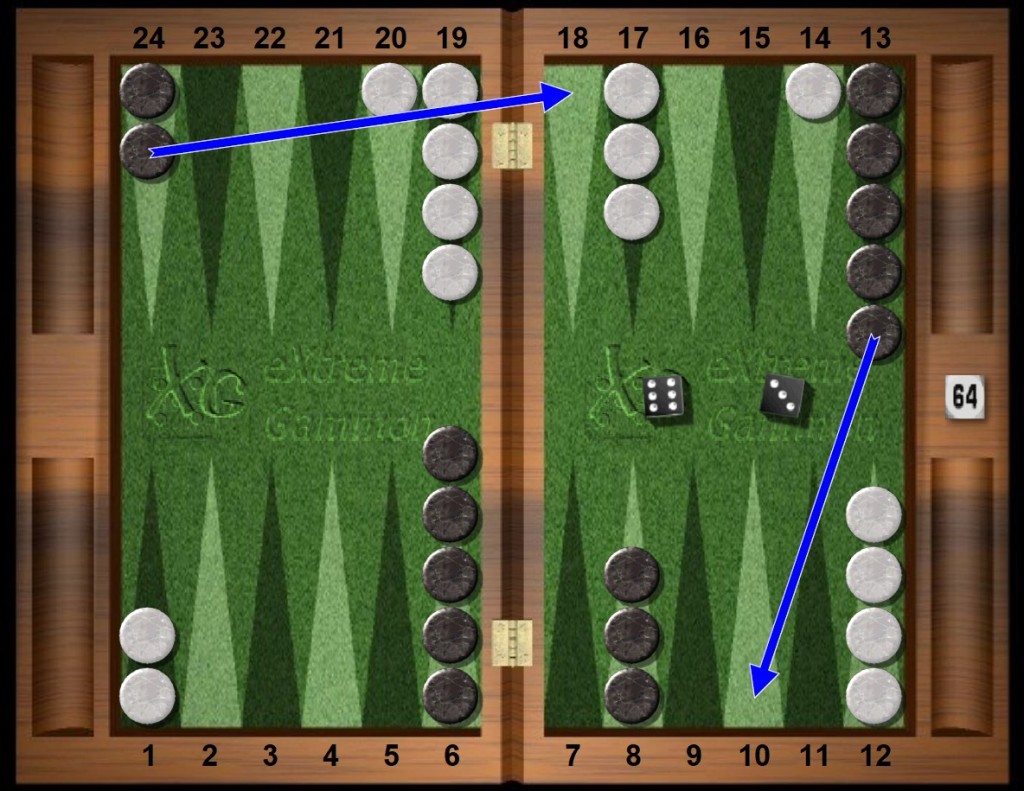
After White’s 12s opening slot, Black’s best opening play of 63s (24/18 13/10) is now the fourth best reply by Black as Responder with an equity loss of 3 cents per dollar. Note the play leaves a triple direct shot (29 shots hit). Nevertheless, Black chooses this small mistake.
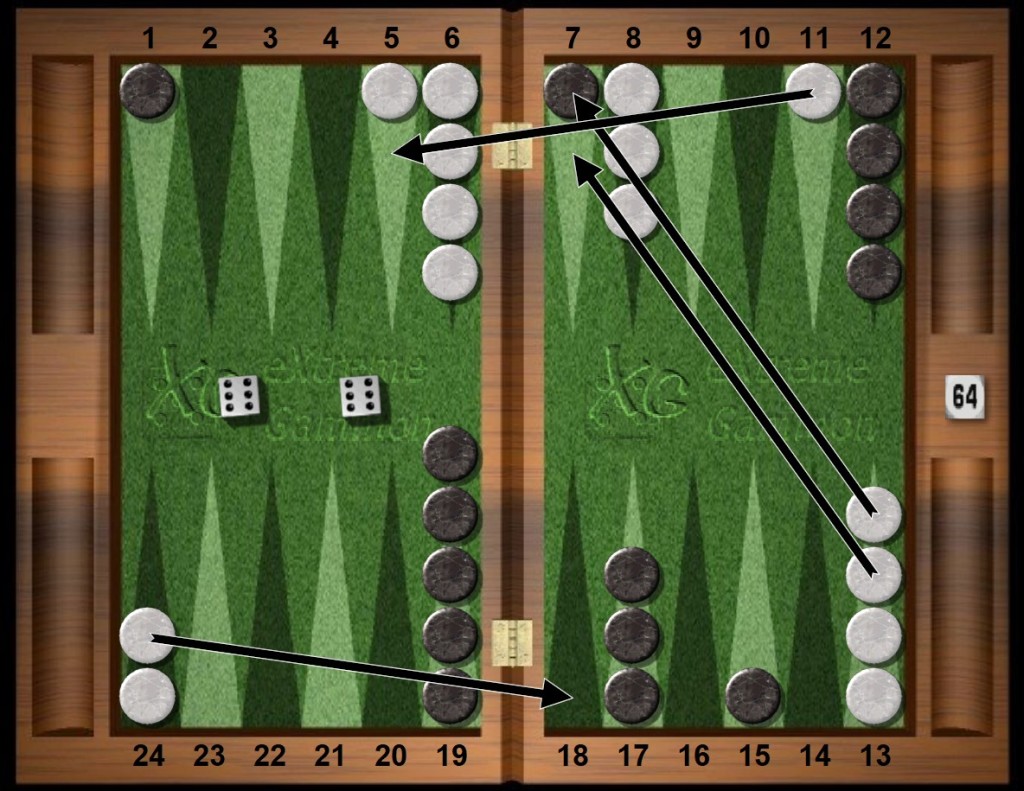
In the game White rolls a monster double 66s which hits Black’s blot and can make two (but not three) of: the golden 5pt, the White barpoint, the Black barpoint. Since an attack is underway White points on the black blot, covers the 5pt, and splits to the defensive 18pt.

Black rolls 41s and chooses to enter high at the front of White’s brewing prime then hits the white blot loose on the black barpoint. A tempo play which may work.

White is on the bar.
White turns the cube with a white checker on the bar. It is a strong double based on roughly two-to-one odds of winning the game and especially a four-to-one chance of winning a gammon.
After some thought Black takes the cube.
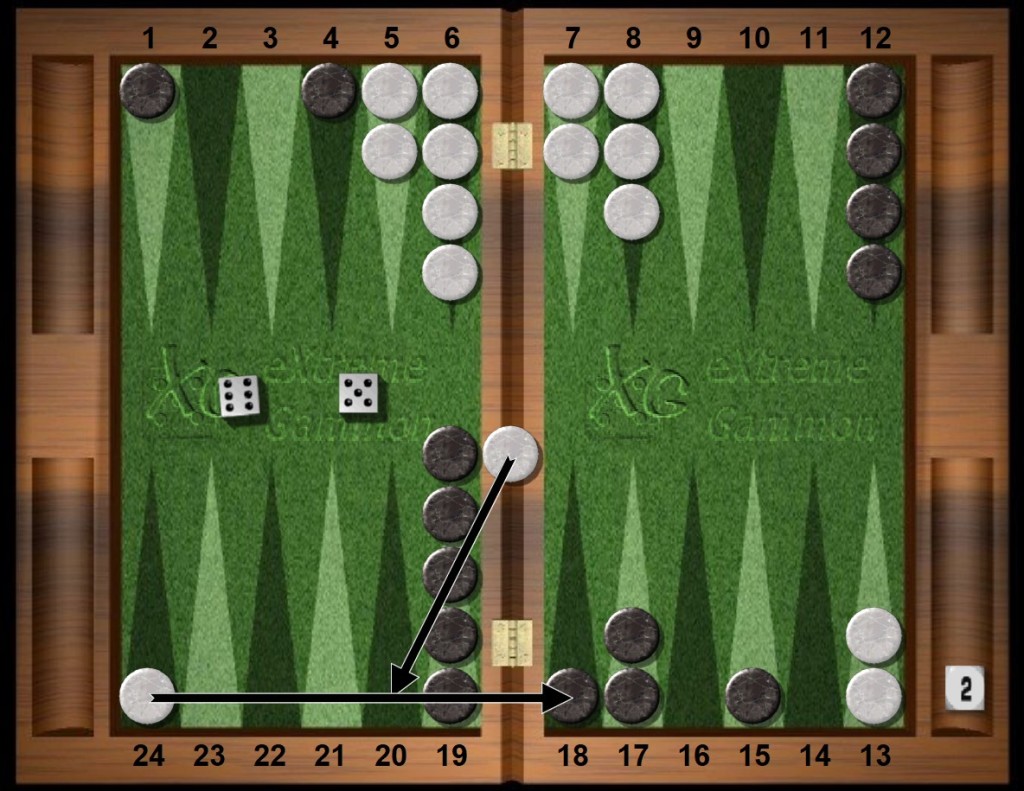
As the followup roll after the Black take, White uses 56s to enter from the bar and hit the black blot on the barpoint.
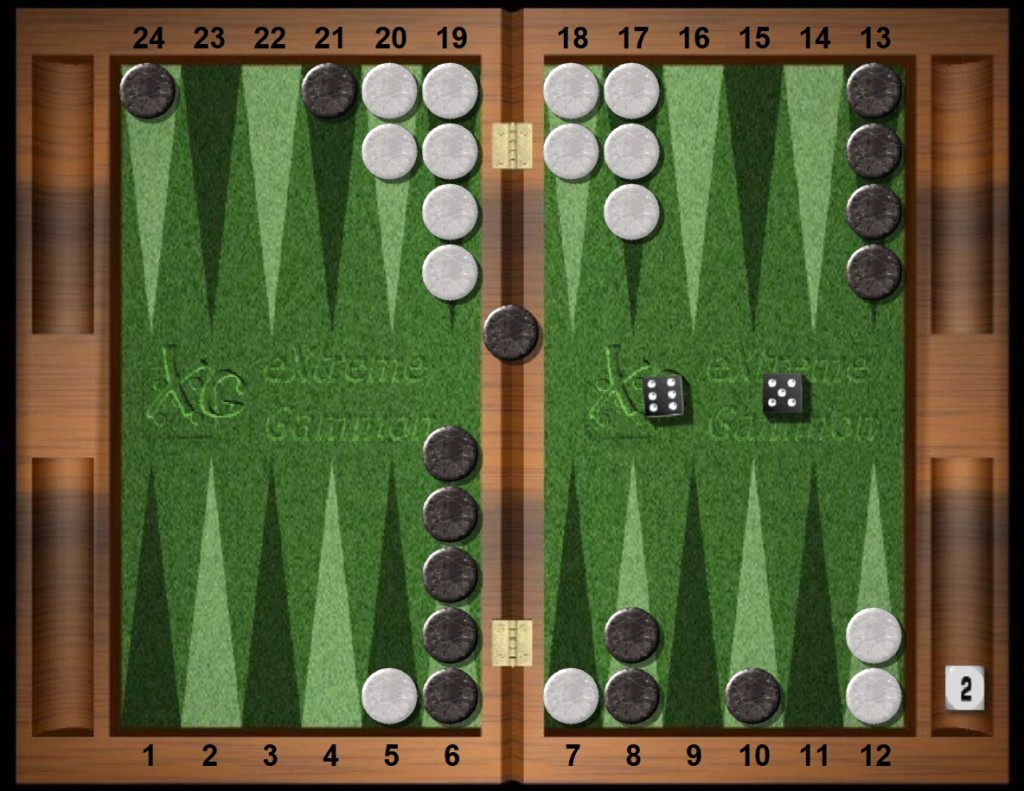
Black dances by rolling 65s.
White is building up steam and, during the rest of the game, steamrolls Black. Eventually, Black loses a gammon — no laughing matter.
 the baron talks backgammon