And now for something a little different. Three backgammon positions appear below. Unlike most backgammon positions found on this website, you are not expected to “solve” anything. Instead, one idea permeates each of the three positions below.
Your mission (should you decide to accept it) is to compare these three positions.
First, place a qualitative label on the strength of Black’s position in each case. Use your opinions on cube actions to label each. For example: Black should not Double and White can Beaver; or Black should not Double and White can Take; or Black should Double and White can Take; or Black should Double and White should Pass.
Second, after labeling each position by cube action, make an estimate of the equity on average that Black can expect to win if the game is finished from here a zillion time. In other words, if the stake is $1 how many cents does Black expect to win starting from this exact position. Note: after the cube action (if any) Black is on the roll.
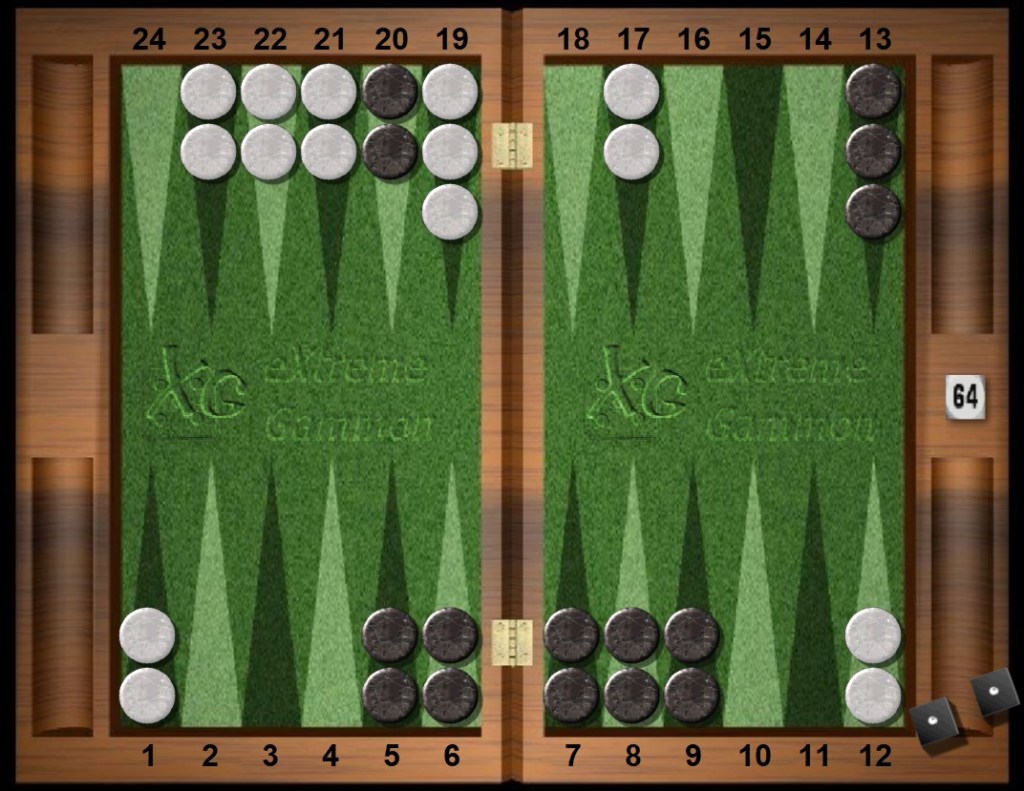
Position 1. This position is from a game.
Black is on the roll. Black is considering a first Double. Black has a high anchor and White has a deep anchor. Both Black and White have an outfield presence. White leads in the pipcount by almost three average rolls (23 pips difference). White has the better home board but Black has a blockade, namely a 5-prime between the 5pt and 9pt.
Qualitative cube actions? Guess as to Black’s equity?
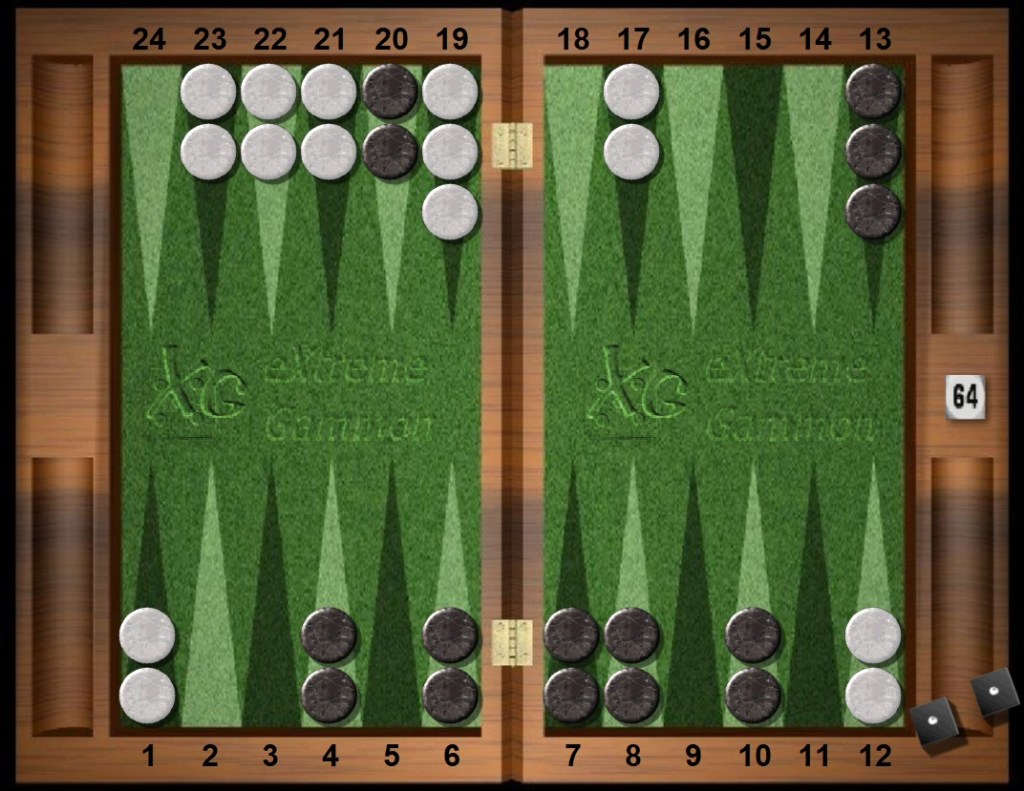
Position 2 — exactly the same pipcount, same structure on both sides of the board except Black’s prime has gaps between the 4pt and the 10pt.
Qualitative cube actions? Guess as to Black’s equity?
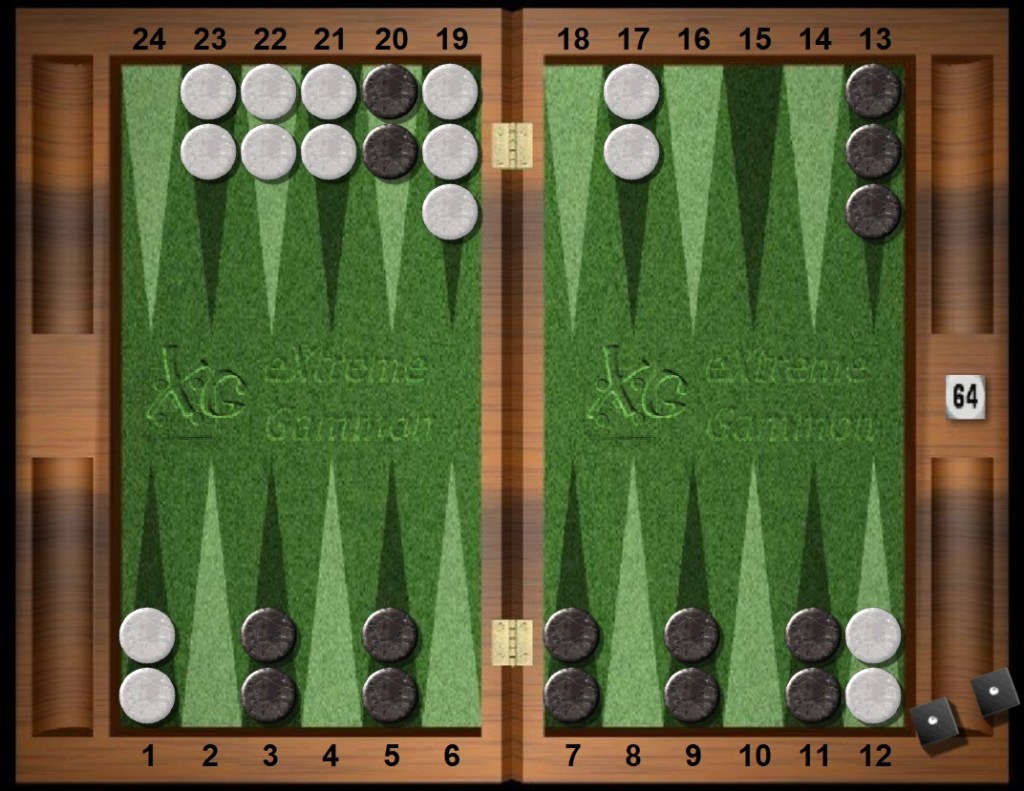
Position 3 — exactly the same pipcount, same structure on both sides of the board except Black’s blockade has gaps between the 3pt and the 11pt.
Qualitative cube actions? Guess as to Black’s equity?
Finished? Please state in a brief paragraph what this kooky lesson teaches.
Data: From rollouts, in Position 1 with the solid 5-prime Black is Double and White an easy Pass. Black’s equity is about 96 cents on the dollar before cubing, hence $1 after D/P.
From rollouts, in Position 2 with the two-gap prime Black is Double and White an easy Take. Black’s equity is currently about 71 cents on the dollar and grows slightly to 74 cents after cubing.
From rollouts, in Position 3 with a four-gap blockade Black is No Double and White a very easy Take (almost a Beaver). Black’s equity decreases by incorrectly cubing here from 23 cents to a mere penny. Giving away the cube has consequences.
The moral of the story? Beware of gaps in a blockade !
Kooky, huh?
 the baron talks backgammon
Mind the gap! And stand clear of the closing doors, please.
LikeLike